Cloth Hall (Sukiennice), Kraków
Sukiennice
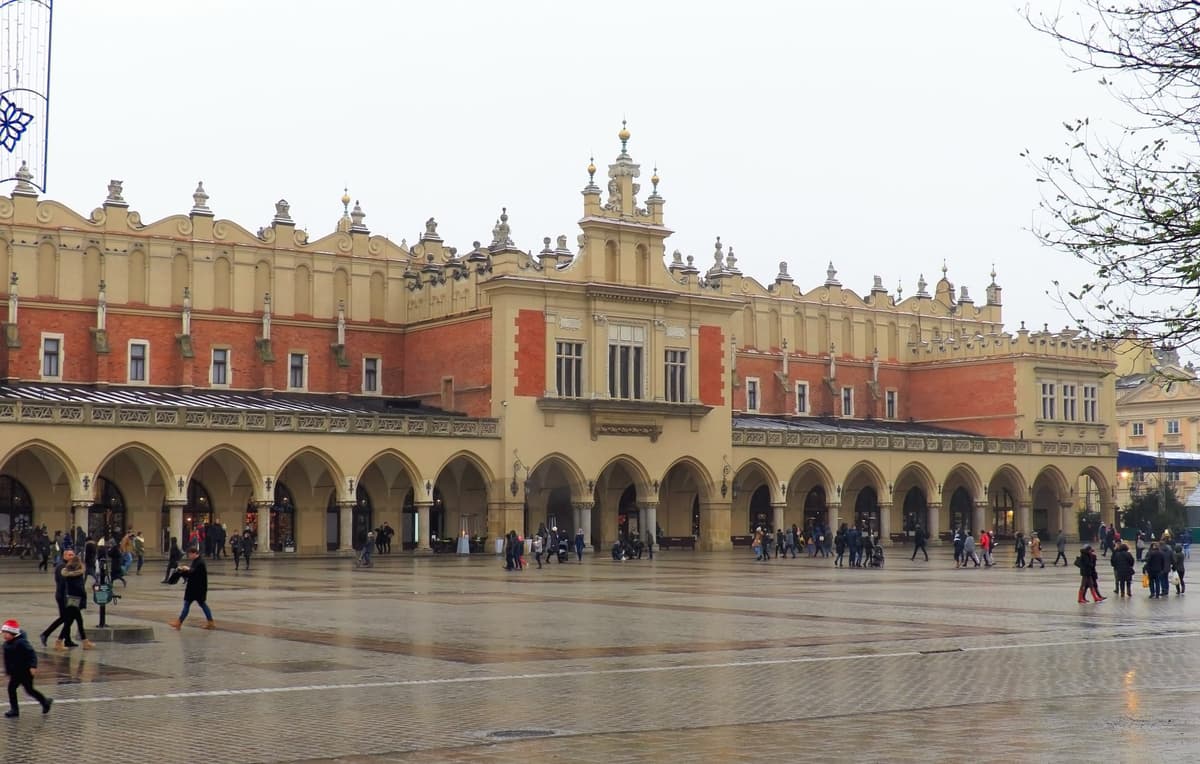
The Cloth Hall (Sukiennice) is the long market hall in the middle of the Main Square in Kraków Old Town. Its ground floor is a passage of stalls selling jewellery, souvenirs and crafts. Upstairs, the National Museum's Gallery of 19th-Century Polish Art is open Tuesday to Sunday, and the hall of stalls is free to walk through.
Updated
Key facts
- Gallery
- Paid, PLN 35Free on Tuesdays
- Gallery hours
- 10:00 to 18:00Tuesday to Sunday, closed on Mondays
- Stalls
- Ground floorJewellery, souvenirs, crafts
- Built
- 13th centuryRebuilt 1556–1559 after a fire
- Size
- About 104 × 26 mAs first built
- Access
- Lift to the galleryEntrance without a threshold
What the Cloth Hall is
The Cloth Hall stands in the middle of the Main Square, on a north-south axis. As first built it measured about 104 × 26 m, and it has been rebuilt many times since. It began as a lane of stalls closed at night to keep the merchants and their carts safe. The town charter of 1257 allowed the cloth trade, and in the 13th century the lane was given a wooden roof: the first Cloth Hall.
The market hall became Gothic in the 14th century and was rebuilt in the Renaissance manner in the middle of the 16th. Its ground floor is still a market, and the floor above holds a gallery of the National Museum. Its address is Rynek Główny 1/3.
- Cloth HallThe market hall in the middle of the square.
- Gallery of 19th-Century Polish ArtThe National Museum’s gallery upstairs, Rynek Główny 3.
- Adam Mickiewicz monumentThe poet’s monument in front of the hall.
- Town Hall TowerThe tower of the old town hall, west of the hall.
- Rynek UndergroundThe museum under the square.
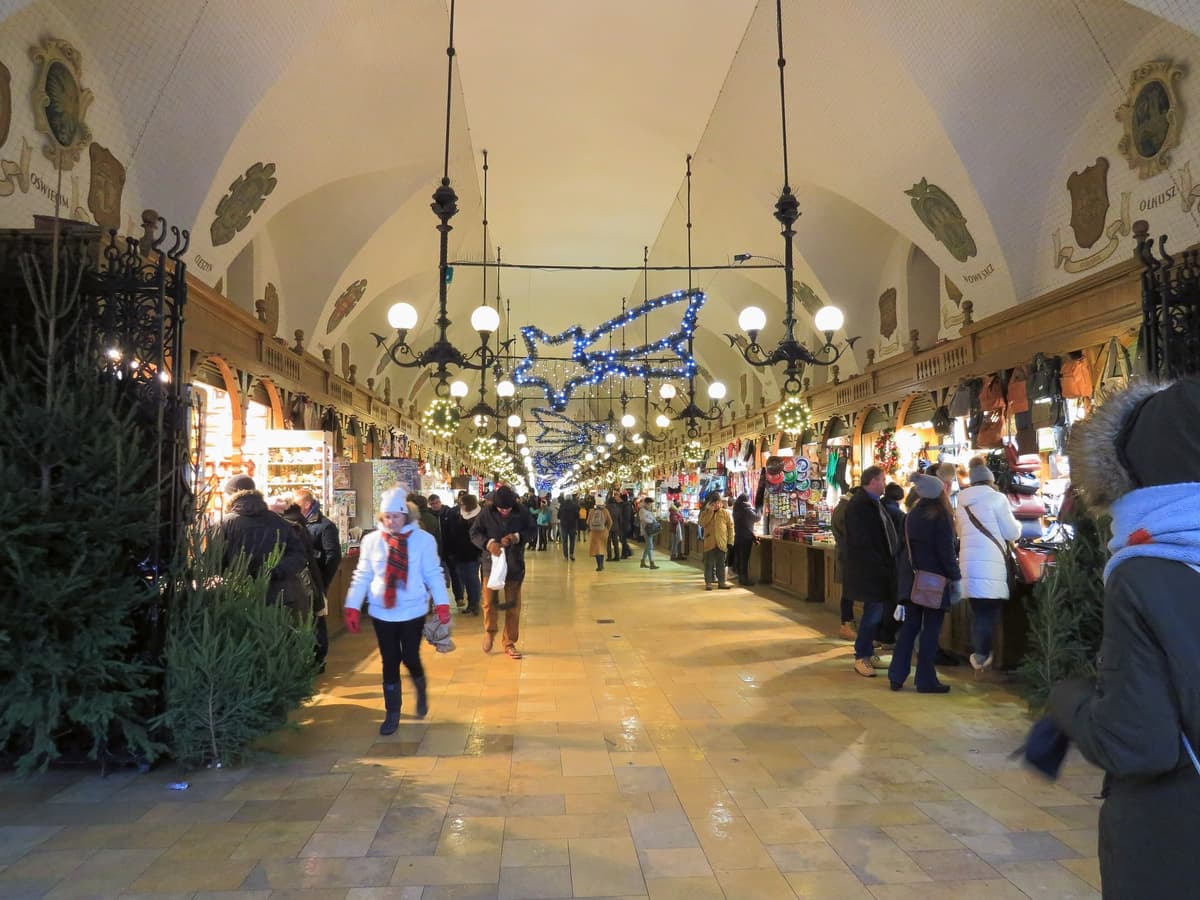
The stalls on the ground floor
The ground floor is a long hall of stalls, open to walk through. In 2018 it held 55 stalls in two rows, selling jewellery, souvenirs and handicraft. The hall has served traders since it was built.
The coats of arms on the ceiling were added after the Second World War: they belong to towns that Poland regained. The building has looked the same since the end of the 19th century.
Some of the stalls are among the souvenir and folk-art shops of the Old Town.
The Gallery of 19th-Century Polish Art
Visiting the gallery
- Tuesday to Sunday
- 10:00 to 18:00
- Closed
- On Mondays
- Ticket
- PLN 35
- Reduced PLN 25
- Pupils and students
- PLN 1
- Up to the age of 26, with a valid card
- Free day
- On Tuesdays
- With a free pass from the box office
The Gallery of 19th-Century Polish Art (Galeria Sztuki Polskiej XIX wieku) is on the floor above the stalls. It belongs to the National Museum in Kraków, which the city council founded on 7 October 1879. The museum's first exhibition opened on 11 September 1883 in two rooms of the Cloth Hall, and from 1901 the museum held the rooms upstairs.
Last visitors are let in 20 minutes before closing. Individual visitors need no booking: tickets are sold at the box office and online. On Tuesdays the permanent exhibitions of the National Museum's branches are free, and individual visitors pick up a free pass at the box office.
A ticket also lets you into eight smaller branches of the National Museum, once each, within 3 months of buying it. The Rynek Underground belongs to another institution, the Museum of Kraków, and has its own ticket.
What hangs in the gallery
The rooms follow the periods of 19th-century art, each under the name of a painter: Marceli Bacciarelli, Piotr Michałowski, Henryk Siemiradzki and Józef Chełmoński. The paintings and sculptures run from the Enlightenment and Romanticism through Academicism to Realism, Impressionism and the early Young Poland movement.
Nero’s Torches (Pochodnie Nerona), Henryk Siemiradzki
Siemiradzki gave the painting to the public at the founding of the National Museum, as the seed of its collection.
Kościuszko at Racławice (Kościuszko pod Racławicami), Jan Matejko
One of the monumental canvases painted in the circle of the academic painters.
The Prussian Homage (Hołd pruski), Jan Matejko
Another monumental canvas by Matejko. His Battle of Grunwald is not here: it belongs to the National Museum in Warsaw.
Somosierra, Piotr Michałowski
A battle scene in a mountain pass.
Four-in-Hand (Czwórka), Józef Chełmoński
A team of horses racing towards the viewer, at the end of the axis of its room.
Frenzy (Szał), Władysław Podkowiński
It hangs beside Jacek Malczewski’s Introduction and The Painter’s Inspiration.
The terraces and the café
After 2000 the gallery was renovated and gained new spaces on the ground floor, the mezzanine and the terraces of the Cloth Hall. A lift inside the building reaches the gallery and the terraces, wheelchairs included, and the entrance has no threshold.
The Sukiennice branch has a café for visitors. On the open paving of the square, only the cafés of the Cloth Hall and of the Town Hall Tower’s cellars may set out tables, under the rules of the Main Square.
Arcades, mascarons and the knife
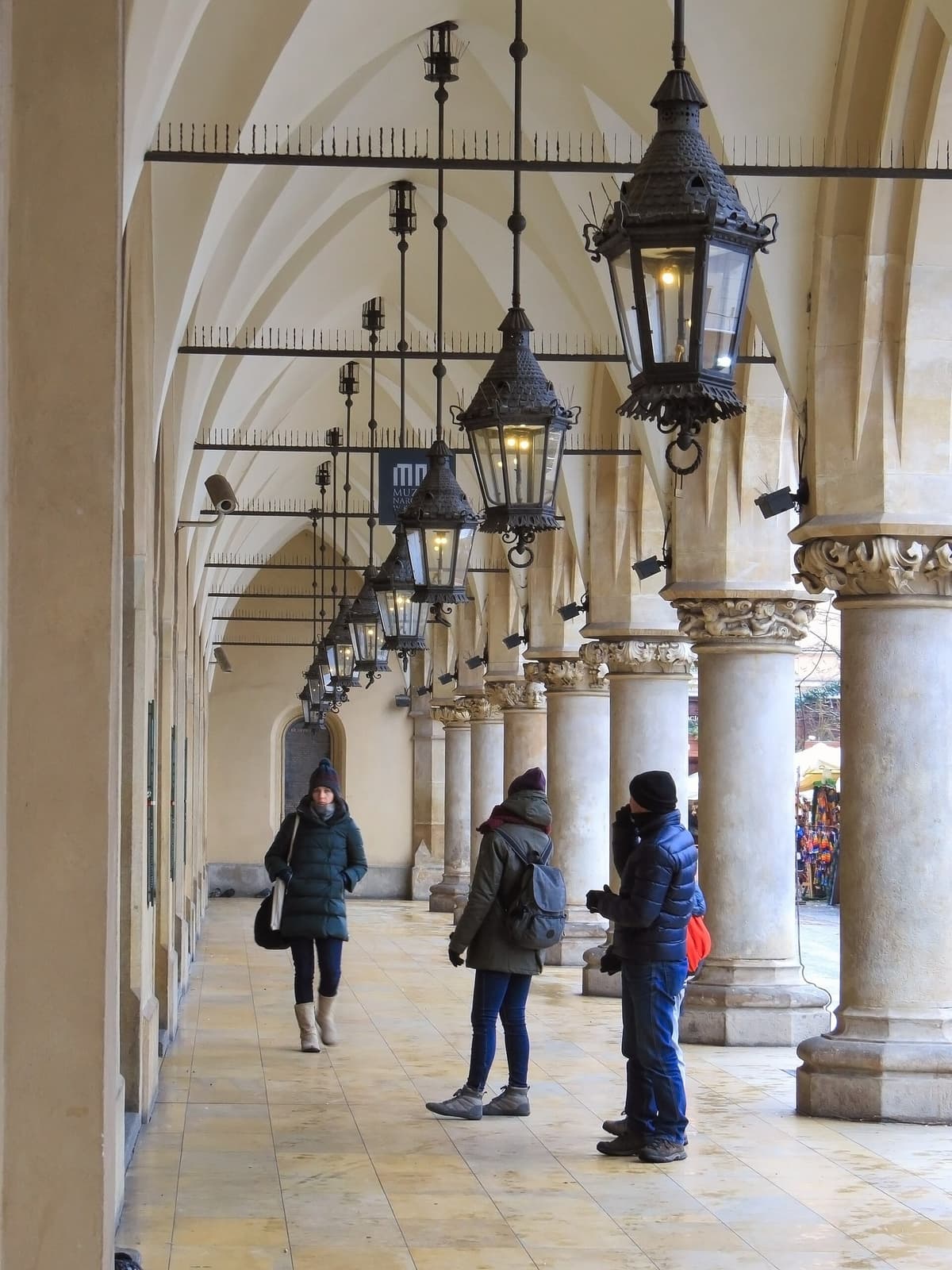
The arcades along both long sides come from Tomasz Pryliński's restoration of 1875–1879. He pulled down the outer stalls and built pointed arcades along both sides and projecting bays at the cross passage.
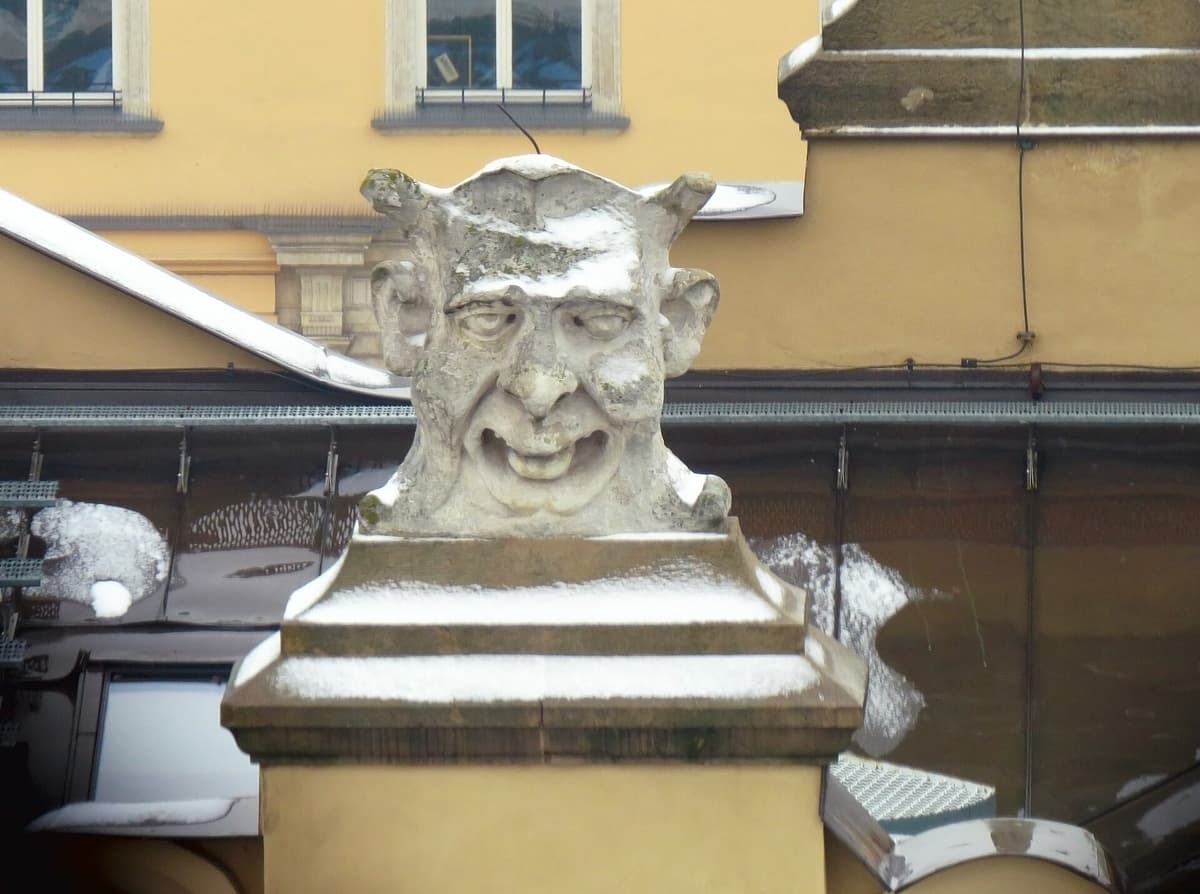
The parapet on top is lined with mascarons, carved faces of people and beasts. Santi Gucci, an Italian architect and sculptor of the late Renaissance working in Poland, carved their models for the city council. The mascarons on the bays are caricatures of the city’s mayors, after designs by Jan Matejko.
A knife hangs in the passage of the Cloth Hall. Legend ties it to the towers of St Mary’s Basilica: one of the two brothers who built them killed the other, and the knife is said to be the murderer’s.
The Cloth Hall in history
1257
The town charter allows the cloth trade. The stalls stand in a lane closed at night.
13th century
The lane of stalls is given a wooden roof: the first Cloth Hall.
1358
Casimir the Great founds a brick hall: two rows of stalls along a covered central hall 108 m long and 10 m wide.
1555
A fire destroys the hall.
1556–1559
Master Pankracy rebuilds it in the Renaissance manner, with J. M. Padovano, Santi Gucci and J. Frankstein.
1601
A passage from east to west is cut across the hall.
1875–1879
Tomasz Pryliński restores the building, with Jan Matejko’s backing. Balls and patriotic ceremonies are held in it afterwards.
7 October 1879
The city council founds the National Museum, which opens its first exhibition in the Cloth Hall.
2000
After this year the gallery is renovated and gains rooms on the ground floor and the terraces.
Frequently asked questions
What is inside the Cloth Hall in Kraków?
The ground floor is a hall of stalls selling jewellery, souvenirs and crafts, open to walk through. Upstairs is the National Museum’s Gallery of 19th-Century Polish Art, with terraces and a café. Under the square, spaces reached from the building belong to the Museum of Kraków.
Is the Cloth Hall gallery free on Tuesdays?
Yes. On Tuesdays the permanent exhibitions of the National Museum's branches, the Cloth Hall gallery included, are free. Individual visitors pick up a free pass at the box office before going in. The gallery is closed on Mondays.
How much is a ticket to the Sukiennice gallery?
A regular ticket costs PLN 35 and a reduced one PLN 25. Pupils and students up to the age of 26 pay PLN 1 with a valid card. The ticket also opens eight smaller branches of the National Museum within 3 months. The gallery is open Tuesday to Sunday, 10:00 to 18:00.
Which paintings hang in the Cloth Hall gallery?
Among them are Henryk Siemiradzki’s Nero’s Torches, Jan Matejko’s Prussian Homage and Kościuszko at Racławice, Piotr Michałowski’s Somosierra, Józef Chełmoński’s Four-in-Hand and Władysław Podkowiński’s Frenzy. Matejko’s Battle of Grunwald is not in Kraków: it belongs to the National Museum in Warsaw.
Why does a knife hang in the Cloth Hall?
Legend ties it to the two unequal towers of St Mary’s Basilica. Two brothers built them, and the younger, out of jealousy, killed the elder. The knife said to be the murderer’s hangs in the passage of the Cloth Hall as a reminder of the deed.