Walking tour of Kraków Old Town
The Royal Road is the walk through Kraków Old Town that coronation entries took: from St Florian’s church through St Florian’s Gate, along Floriańska, across the Main Square and down Grodzka and Kanonicza to Wawel. It is 1.9 km, 26 min on foot without stops. Free walking tours and horse carriages start on the way.
Updated
Key facts
- The Royal Road
- 1.9 km26 min on foot without stops
- Start
- St Florian’s churchOn plac Matejki, 13 min on foot from the Main Square
- End
- Herbowa Gate, Wawel13 min on foot from the Main Square, up a ramp
- University loop
- 940 m13 min on foot, from the Main Square and back
- Free walking tours
- Pay what you wishBooking needed
- Horse carriages
- On the Main SquareFrom Szewska to św. Jana
The Royal Road, stop by stop
From St Florian’s church to the Herbowa Gate of Wawel the route is 1.9 km: 26 min on foot without stops. It follows the way of coronation entries, funerals and processions, which almost exactly matches the longest straight line inside the Planty.
- St Florian’s churchThe start, on plac Matejki.
- Kraków BarbicanThe bastion in front of the gate.
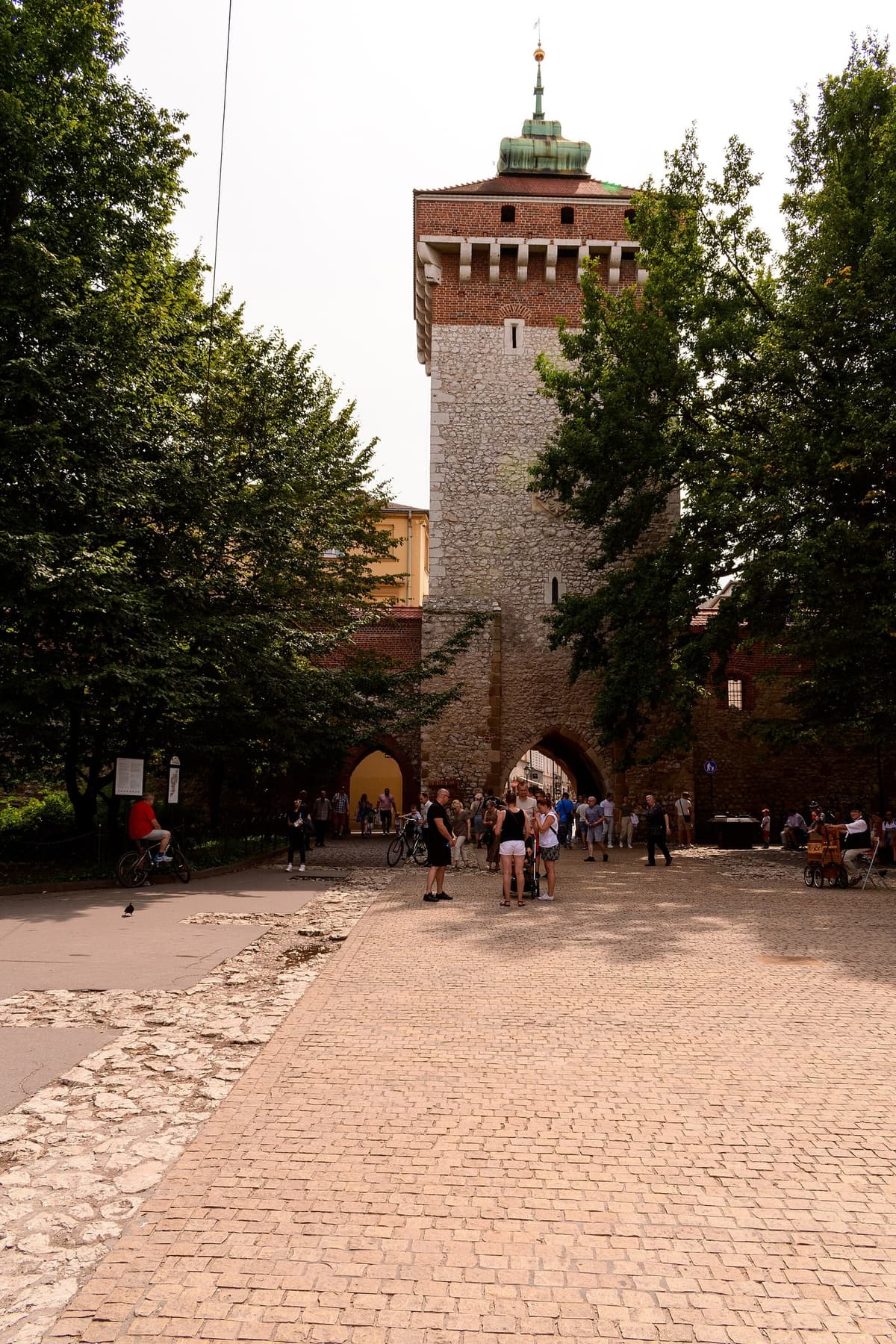
- St Florian’s GateThe gate into the Old Town.
- FloriańskaThe street from the gate to the Main Square.
- Main SquareThe middle of the square, by the Cloth Hall.
- GrodzkaThe street from the square towards Wawel.
- KanoniczaThe canons’ street below Wawel.
- Herbowa Gate, WawelThe gate at the top of the ramp to Wawel Hill.
St Florian’s church
The Royal Road starts on plac Matejki, by the Grunwald Monument of 1910, the Academy of Fine Arts and St Florian’s church on the corner. The church was Karol Wojtyła’s first parish in Kraków, where he worked mainly with students.
Kraków Barbican
Built in 1498–1499 in front of the gate. The Barbican and the city walls share one paid ticket.
St Florian’s Gate
61 m from the Barbican, 1 min on foot. Through the gate Floriańska opens ahead, with the towers of St Mary’s at its end.
Floriańska
A busy shopping street of houses rebuilt in the 19th century, with the Jan Matejko House, the Pod Różą hotel and the Jama Michalika café.
Main Square
The market square, about 200 m a side, with the Cloth Hall, the Town Hall Tower and St Mary’s Basilica, where Floriańska comes in.
Grodzka
Grodzka leaves the square not at a right angle, and by St Adalbert’s church the cobbled way straight to Wawel begins. It passes plac Dominikański, plac Wszystkich Świętych and plac Marii Magdaleny.
Kanonicza
Parallel to Grodzka and once part of the Royal Road, Kanonicza held the houses of the cathedral canons and leads straight to Wawel, which comes into view as you turn into it.
Herbowa Gate, Wawel
The route ends at the castle, where a ramp climbs to the Herbowa Gate of Wawel.
What each street of the Royal Road is
In the 14th century Kraków had 42 named streets, and the first named in documents are Grodzka, Wiślna, Floriańska, Bracka and Sławkowska. Along the Royal Road, on Floriańska, Grodzka and Kanonicza, café gardens may not put up umbrellas; the Main Square is the exception.
Floriańska
You enter Floriańska through St Florian’s Gate, with St Mary’s towers ahead. Most of its houses were rebuilt in the 19th century. Look for the Kmita residence at no. 13, the Pod Różą hotel with its Renaissance portal at no. 14, the Pharmacy Museum of the Jagiellonian University, the Jan Matejko House at no. 41 and the Jama Michalika café. The street was fully renovated by 2006.
Grodzka
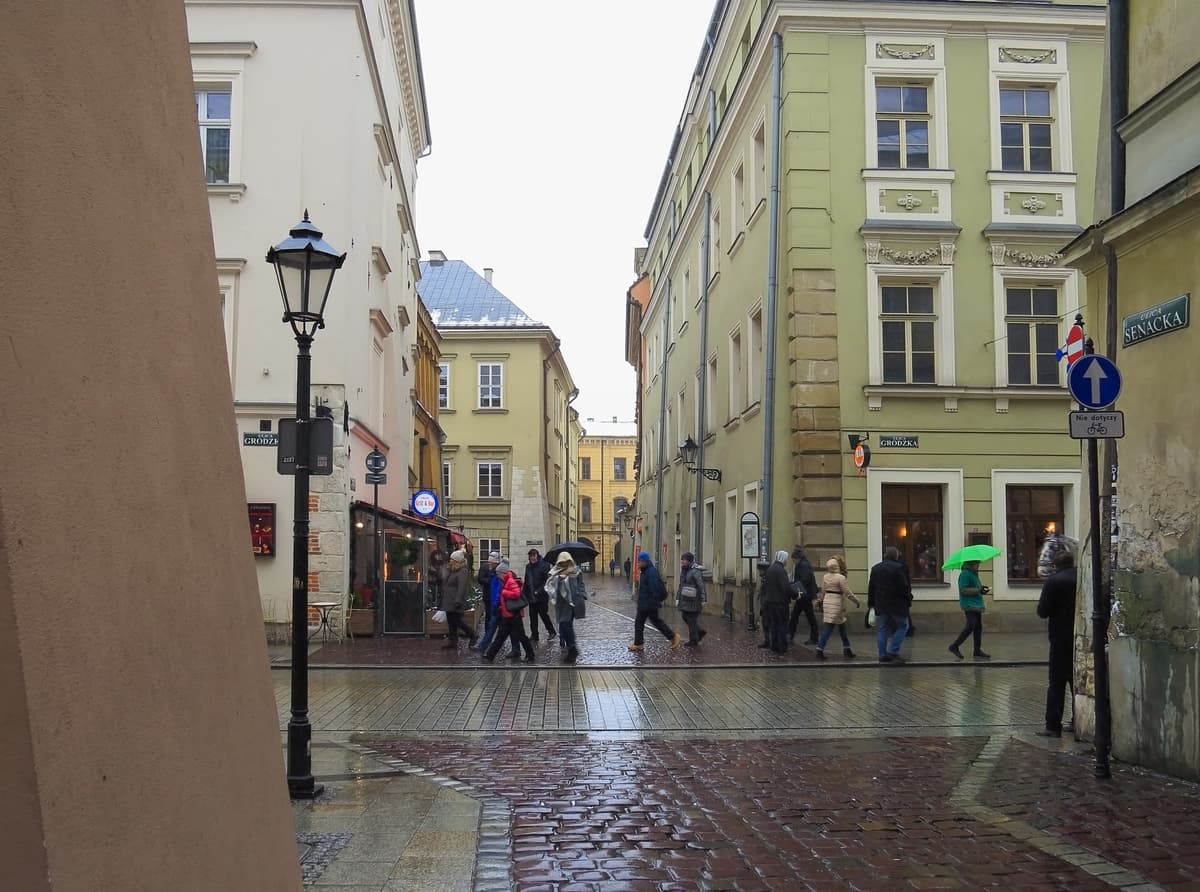
The stretch to plac Wszystkich Świętych is full of shops and restaurants. The Wielopolski Palace there, a Renaissance residence of the 16th century, has been the seat of the city since the town bought it in 1864. The Wyspiański Pavilion, opened in 2007, holds an InfoKraków point and three stained-glass designs by Wyspiański made for the cathedral and never built there.
By plac Dominikański and plac Wszystkich Świętych stand the Gothic friaries of the Dominicans and the Franciscans; the Franciscan church has Wyspiański’s wall paintings and stained glass. Further on lie plac Marii Magdaleny, the centre of the early settlement of Okół, which the Tatars destroyed in the 13th century, and the churches of Sts Peter and Paul and St Andrew. Collegium Iuridicum, founded by King Władysław Jagiełło early in the 15th century, held lecture rooms and the lawyers’ library.
From plac Marii Magdaleny Grodzka goes on past the Evangelical St Martin’s and little St Giles to the Arsenal and the former primate’s palace at no. 65. The street was fully renovated by 2008.
Kanonicza
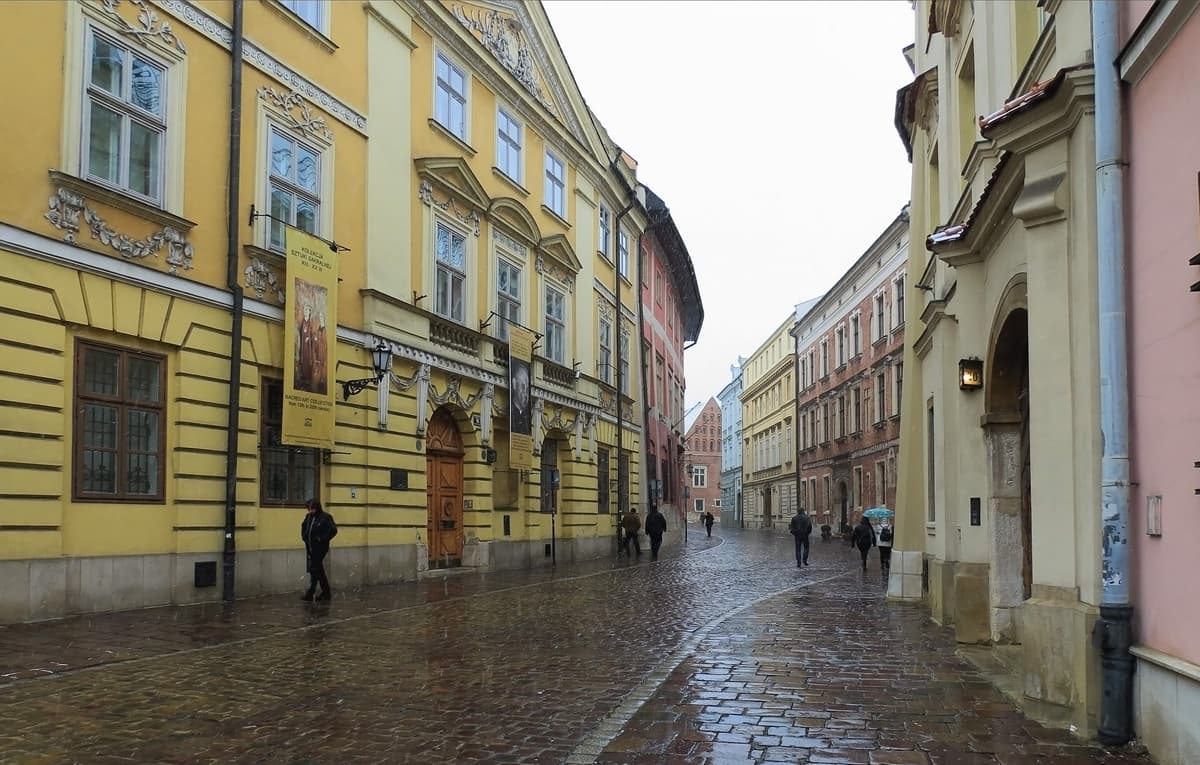
Kanonicza runs parallel to Grodzka from Senacka to Podzamcze and leads straight to Wawel. It was once part of the Royal Road and held the houses of the cathedral canons; its Gothic, Renaissance and Mannerist houses are lit in the evening.
At the Wawel end stands the Jan Długosz House at no. 25, from the 14th century and once a royal bath house; from 1450 the royal chronicler Jan Długosz lived in it, and Stanisław Wyspiański spent his childhood there. The Górka Palace is at no. 24, the Bishop Erazm Ciołek Palace at no. 17 is a branch of the National Museum, and the Archdiocesan Museum is at nos. 19 and 21, in the Deanery House where Karol Wojtyła lived as auxiliary bishop.
5 min walk
Floriańska
340 mThe middle of the street.
6 min walk
Grodzka
380 mBetween plac Dominikański and Poselska.
8 min walk
Collegium Iuridicum
550 mOn Grodzka.
9 min walk
Plac Marii Magdaleny
600 mWhere Grodzka and Kanonicza part.
10 min walk
Plac Matejki
750 mThe square where the Royal Road begins.
10 min walk
Grunwald Monument
740 mOn plac Matejki.
10 min walk
Kanonicza
680 mThe middle of the street.
13 min walk
St Florian’s church
910 mOn the corner of plac Matejki.
18 min walk
Wawel pier
1.5 kmOn Bulwar Czerwieński, for boats on the Vistula.
A second loop through the university quarter
A second walk leaves the Main Square for the university quarter: Collegium Maius, the gate of the Professors’ Garden, Collegium Novum, built in 1887, and St Anne’s church, then back to the square. The loop is 940 m, 13 min on foot.
The Planty run both ways from the Barbican to Wawel Hill. Between them the western half of the ring, past the university, is about 1.5 km, the eastern half about 2.0 km.
- Main SquareStart and end of the loop.
- Collegium MaiusOn Jagiellońska.
- Professors’ Garden gateThe way into the garden.
- Collegium NovumThe university’s new main college.
- St Anne’s churchOn św. Anny.
Free walking tours and guided walks
A free walking tour has no fixed price: you book a place, join the walk and decide at the end what it was worth.
Walkative
Its pay-what-you-wish Old Town tour meets between St Florian’s Gate and the Barbican; the nearest tram stops are Stary Kleparz and Teatr Słowackiego. Booking is obligatory, and groups of 8 or more cannot join. It also runs a tour of Jewish Kraków, Kazimierz and the wartime ghetto.
Kraków Explorers
Its free walk meets in front of St Mary’s Basilica on the Main Square, by the orange umbrella, and takes 2 to 2.5 hours. A place is booked in advance.
Horse carriages and electric carts
Where they stand
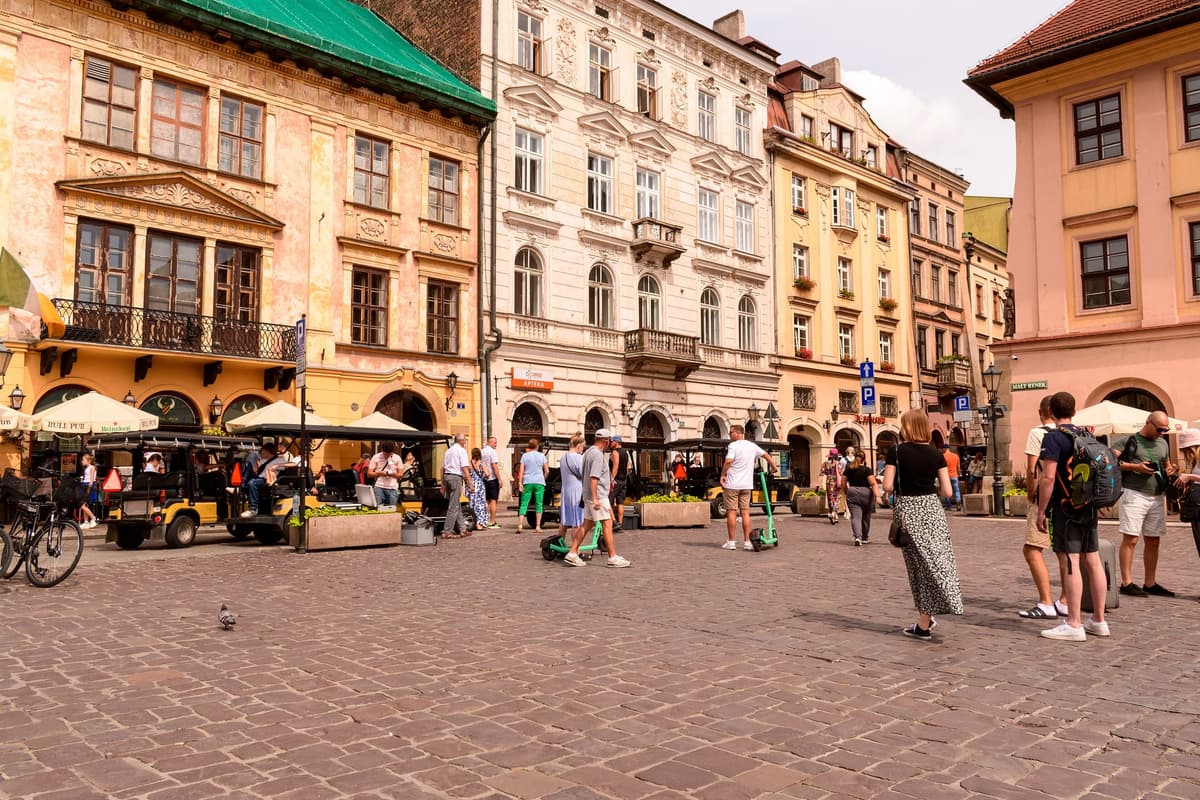
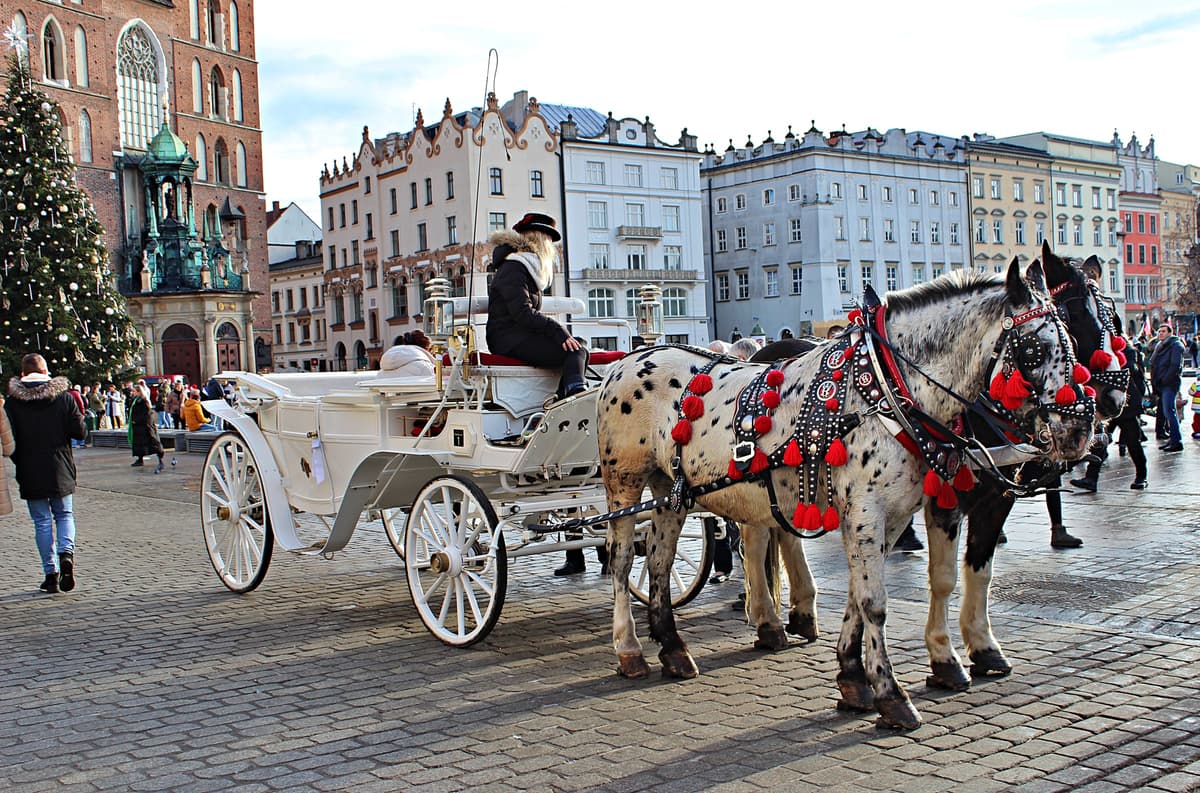
Horse-drawn carriages wait on the Main Square, on the stand from the end of Szewska to the end of św. Jana. Each driver needs a contract with the city for a place there.
The price list
Each carriage must carry its price list, a sticker with its side number and a plate with its owner’s name and address. Adverts on carriages are not allowed.
The carriages
Two types are allowed, the Victoria and Lando, drawn by one horse or two, with an adult helper beside the driver. On the Main Square they go at a walk only.
The horses
Horses must be at least 5 years old; stallions, geldings and pregnant mares may not be used. They are put to the carriages every other day, and drivers may not use the whip to punish them.
In the heat
When the thermometer on the Cloth Hall shows more than 28 °C, carriages leave the main stand in the afternoon for shaded stands in the Planty: between Sienna and Mikołajska, between Podzamcze and Poselska, and by Mikołajska on plac Mariacki.
Electric carts
Besides carriages, paid rides in the Old Town cultural park are allowed only in electric carts, buses, trams and taxis. Each cart needs an identifier, issued for a year after a contest run by the mayor, and no more than 70 carts may have one.
Where carts go
Carts may carry passengers only on the streets the cultural park’s resolution marks on its map. A cart has at most eight seats.
No loudspeakers
Loudspeakers on the carts are banned; only individual headphones are allowed. Breaking the cultural park’s rules is an offence under local law.
River cruises below Wawel
Sightseeing boats sail through Kraków and on to Tyniec from the Wawel pier on Bulwar Czerwieński, by the Grunwaldzki bridge near the Dragon’s Den, 18 min on foot from the Main Square.
Frequently asked questions
How long does the Royal Road walk take?
The Royal Road from St Florian’s church to the Herbowa Gate of Wawel is 1.9 km, 26 min on foot without stops. The last stretch climbs a ramp to Wawel.
Where do free walking tours in Kraków start?
The Walkative tour meets between St Florian’s Gate and the Barbican, and the Kraków Explorers walk in front of St Mary’s Basilica on the Main Square. Both ask you to book, and neither has a fixed price: you decide at the end what the walk was worth.
How much does a horse carriage ride in Kraków cost?
The price is on the carriage: each one must carry its own price list. The carriages wait on the Main Square between Szewska and św. Jana.
Do the horse carriages run in hot weather?
Yes, but in the afternoon not from the main stand. When the thermometer on the Cloth Hall shows more than 28 °C, the carriages move to stands in the shade of the Planty, between Sienna and Mikołajska, between Podzamcze and Poselska, and by plac Mariacki.
Can electric carts drive anywhere in Kraków Old Town?
No. Carts may carry passengers only on the streets the cultural park’s resolution marks on its map, and only with a yearly identifier from the city; at most 70 carts may have one. Loudspeakers on them are banned.