Kazimierz from Kraków Old Town

Kazimierz is the historic town south of Kraków Old Town, shaped by its Jewish and Catholic communities. It was a town of its own from 1335 until it became a district of Kraków in 1800. Szeroka, the centre of its Jewish town, lies 20 min on foot from the Main Square, and seven historic synagogues stand nearby.

Updated

Key facts

From the Main Square
20 min on footTo Szeroka, 1.4 km
A town of its own
1335 to 1800Then a district of Kraków
World Heritage
Since 1978One property with the Old Town and Wawel
Synagogues
Seven historicClosed to visitors on Saturdays
Free day
On MondaysAt the Old Synagogue museum
Tram stops
Miodowa, Plac WolnicaTrams from the city centre

What Kazimierz is and how it relates to the Old Town

Kazimierz grew up as a separate town south of Kraków and received its charter in 1335. In 1800 it became a district of Kraków. Its main street, Krakowska, was part of the trade route from Kraków to Hungary, and its town hall stood on the market square, today’s plac Wolnica.

Jews came to Kazimierz in the middle of the 14th century. At the end of the 15th century a walled Jewish town was set apart for them, with Szeroka at its centre, inside today’s Miodowa, św. Wawrzyńca, Wąska, Józefa and Bożego Ciała. Synagogues, schools and the community’s institutions grew round it. Before the Second World War more than 64,000 Jews lived in Kraków, a quarter of the city.

The Swedish invasion in the middle of the 17th century ended the town’s prosperity. After the Second World War Kazimierz emptied and fell into ruin, and its revival came with the changes after 1989. With the Old Town and Wawel it forms one UNESCO World Heritage property, inscribed in 1978.

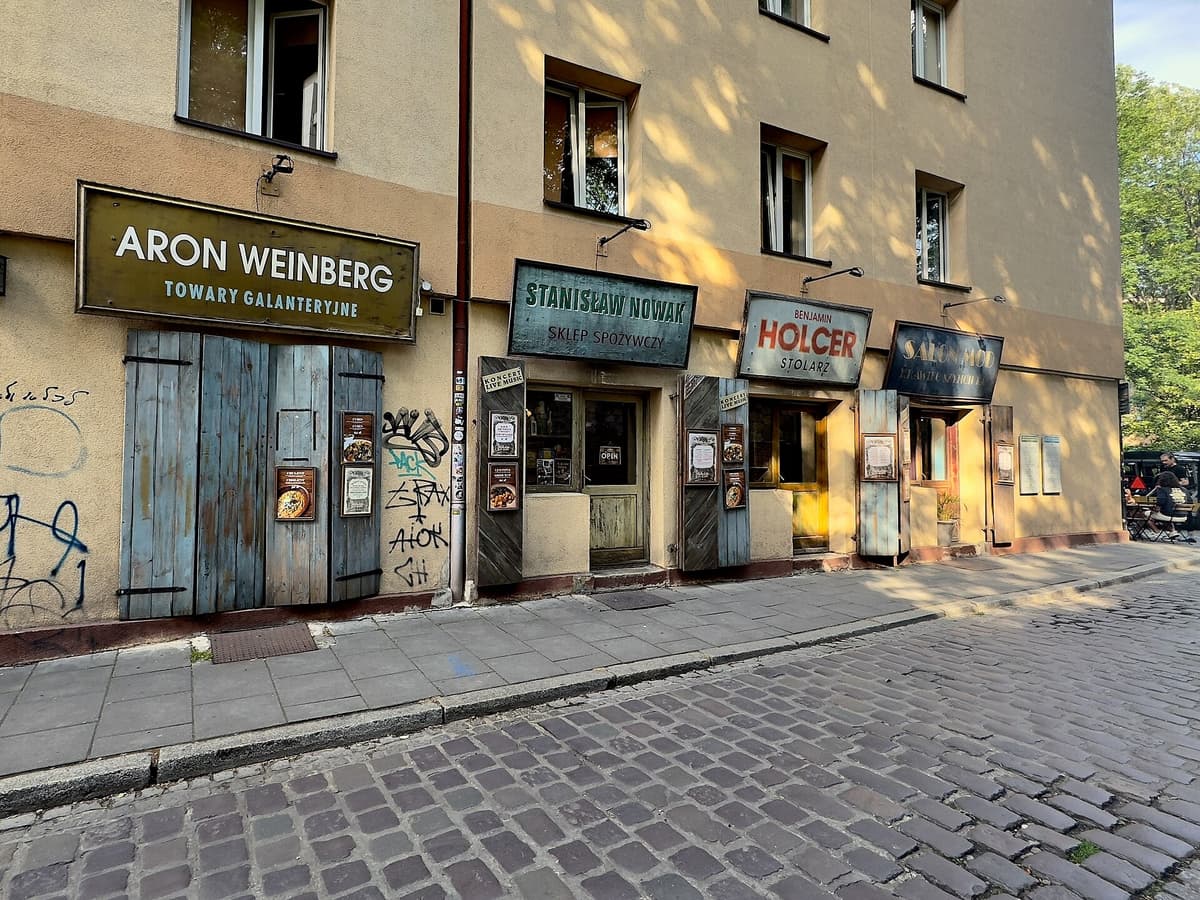
Old-style painted shop signs in Polish above weathered wooden shutters on a pale building, a cobbled street in front in evening sun
Old shop signs painted on a building on Szeroka, June 2025

Walking from the Main Square and from Wawel

Szeroka, the old centre of the Jewish town, lies 1.4 km from the Main Square on the direct walk: 20 min on foot. The line on the map takes a longer way, down Grodzka and through Stradom, the suburb that grew up between Kraków and Kazimierz and linked the two towns: 1.9 km, 26 min on foot.

From the Herbowa Gate of Wawel it is 1.3 km to Szeroka, 18 min on foot. Trams from the city centre stop at Miodowa, 4 min on foot from Szeroka, and at Plac Wolnica, 8 min on foot from plac Nowy.

The Father Bernatek footbridge, opened in 2010, crosses the Vistula from Kazimierz to Podgórze. The walk is short enough to stay at a hotel in the Old Town and come to Kazimierz on foot.

From the Main Square to Kazimierz: the walk down Grodzka and through Stradom, the tram stops and the squares
  1. Main SquareThe middle of the square, by the Cloth Hall.
  2. Herbowa Gate, WawelThe gate at the top of the ramp to Wawel Hill.
  3. SzerokaThe centre of the old Jewish town.
  4. Plac NowyThe square with the round market hall.
  5. Plac WolnicaThe old market square of Kazimierz.
  6. Miodowa tram stopNear Szeroka.
  7. Plac Wolnica tram stopNear plac Wolnica.
  8. Father Bernatek footbridgeAcross the Vistula to Podgórze.
  • 20 min walk

    Szeroka

    1.4 km

    The Old Synagogue and Remuh stand on it.

  • 20 min walk

    Plac Nowy

    1.5 km

    The Okrąglak market hall.

  • 23 min walk

    Plac Wolnica

    1.7 km

    The Ethnographic Museum in the old town hall.

  • 25 min walk

    Skałka

    1.9 km

    The Pauline church and its crypt.

  • 28 min walk

    Father Bernatek footbridge

    2.1 km

    The way on to Podgórze.

Synagogues and Jewish cemeteries

The seven synagogues where Kraków’s Jews prayed, six Orthodox ones and the Progressive Tempel, all stand in Kazimierz.

The Jewish community opens its synagogues to visitors Sunday to Friday and closes them two hours earlier on Fridays, before the Sabbath. They are closed on Saturdays, on Jewish holidays and during prayers. The Old Synagogue is a museum of the city and not one of them.

Synagogue and museum

Old Synagogue

21 min walk 1.5 km

Built in the 15th century on the model of Gothic synagogues in Germany and Bohemia, and given its Renaissance form in 1570 by the Italian builder Mateusz Gucci. Restored after the war, it has been a museum of the city since 1959, with its collection of Judaica. Entry is free on Mondays.

Address
Szeroka 24
Hours
  • Mon 10:00–15:00
  • Tue to Sun 9:00–17:00

Synagogue

Remuh Synagogue

19 min walk 1.4 km

Built about 1558 in the Renaissance style by the merchant and royal banker Israel Isserles Auerbach for his son, Rabbi Moses Isserles, called Remuh. It is the Jewish community’s main synagogue, with daily prayers. Paid entry; closed on Saturdays and on Jewish holidays.

Address
Szeroka 40
Hours
  • Mon to Fri 10:00–16:00
  • Sat closed
  • Sun 10:00–16:00

Cemetery

Remuh Cemetery

19 min walk 1.4 km

The old cemetery beside the Remuh Synagogue. Its gravestones date from 1552 to 1850, and the Austrian authorities closed it in 1800. It was badly damaged in the war and restored after it. About 700 gravestones were found, most of them no longer on their graves, and broken matzevot were set into the wall.

Address
Szeroka 40
Hours
Hours by day
  • Mon 9:00–16:00
  • Tue to Thu 9:00–18:00
  • Fri 9:00–16:00
  • Sat closed
  • Sun 9:00–16:00

Synagogue

Tempel Synagogue

18 min walk 1.3 km

The Progressive synagogue, built from 1860 to 1862 in an eclectic Neo-Renaissance style with Moorish elements. Thoroughly restored after the change of system, it is again a place of prayer, holds concerts of the Jewish Culture Festival and is open to visitors.

Address
Miodowa 24
Hours
  • Mon to Fri 10:00–18:00
  • Sat closed
  • Sun 10:00–18:00

Synagogue

Isaac Synagogue

20 min walk 1.5 km

An early Baroque synagogue, opened in 1644 and founded by Izaak Jakubowicz, a merchant and head of the Kazimierz community. Renovated after the war, it opened to visitors and is used for prayer again. Paid entry; closed on Saturdays and on Jewish holidays.

Address
Kupa 18
Hours
Hours by day
  • Mon to Thu 10:00–18:00
  • Fri 10:00–17:00
  • Sat closed
  • Sun 10:00–18:00

Synagogue

High Synagogue

21 min walk 1.5 km

The third synagogue of the Jewish town, after the Old Synagogue and Remuh, built in the middle of the 16th century. Its prayer hall is on the upper floor, which gave it its name.

Address
Józefa 38

Synagogue

Kupa Synagogue

19 min walk 1.4 km

Built in 1643 from the contributions of the Kazimierz goldsmiths: “kupa” is the word for the community’s fund. The Jewish community does not open it to visitors at present.

Address
Miodowa 27

Synagogue

Popper Synagogue

20 min walk 1.4 km

Built in the 17th century as the private foundation of Wolf Popper, a Jewish merchant and financier.

Address
Szeroka 16
Hours
  • Mon to Thu 10:00–18:00
  • Fri to Sat 10:00–19:00
  • Sun 10:00–18:00

Cemetery

New Jewish Cemetery

19 min walk 1.4 km

Founded in 1801 on land bought from the Augustinians, it is the one Jewish cemetery in Kraków still in use, cared for by the Jewish community.

Address
Miodowa 55
Hours
  • Mon to Fri 10:00–16:00
  • Sat closed
  • Sun 10:00–16:00

Churches, plac Wolnica and the museums

Near the synagogues stand the churches of Corpus Christi and St Catherine, and the procession on St Stanislaus’ day goes to Skałka, the church of the Pauline fathers. Near Skałka a well-kept stretch of the 14th-century walls of Kazimierz survives.

Plac Wolnica is part of the old market square of Kazimierz. Its name comes from the Latin forum liberum, the right of free trade. The fountain with the Three Musicians by Bronisław Chromy has stood on it since 1970.

Church

Corpus Christi basilica

23 min walk 1.7 km

A Gothic church whose interior suffered when King Charles Gustav of Sweden made it his quarters during the siege of Kraków, so its furnishings are almost all Baroque. The pulpit is shaped like a boat.

Address
Bożego Ciała 26
Hours
  • Every day 7:00–19:00

Church

St Catherine’s church

22 min walk 1.6 km

A Gothic church founded by King Casimir the Great, who settled the Augustinians in it; they still look after it. The building was never fully finished.

Address
Augustiańska 7
Hours
  • Mon to Fri 10:00–16:00
  • Sat closed
  • Sun 8:30–13:30, 17:30–19:30

Church and monastery

Skałka

25 min walk 1.9 km

The Pauline church took its final form, with its stairs, from 1740 to 1762. Under it lies the Crypt of the Distinguished, made at the end of the 19th century for Poles who served the national culture. In summer the monks run paid guided tours of the monastery.

Address
Skałeczna 15
Hours
  • Every day 7:00–20:00

Museum

Ethnographic Museum

23 min walk 1.7 km

The permanent exhibition fills the former town hall of Kazimierz on plac Wolnica; temporary exhibitions are in the Esterka House at Krakowska 46. Paid entry, free on Tuesdays for the permanent exhibition, closed on Mondays.

Address
plac Wolnica 1
Hours
  • Mon closed
  • Tue to Sun 10:00–18:00

Museum

Galicia Jewish Museum

22 min walk 1.6 km

A Jewish museum in Kazimierz, open every day. Paid entry.

Address
Dajwór 18
Hours
  • Every day 10:00–18:00

Plac Nowy, cafés and food

Plac Nowy, commonly called the Jewish square, was a trading square from the start. Stalls in the Okrąglak, the round market hall in its middle, sell zapiekanki.

The busiest cafés, artists’ studios and galleries of Kazimierz are on Szeroka, Izaaka, Miodowa, Józefa and Podbrzezie and round plac Nowy.

Market hall

Okrąglak

21 min walk 1.5 km

The round market hall in the middle of plac Nowy, built in 1900. From 1927 the city leased it to the Jewish community as a ritual poultry slaughterhouse; today stalls in it sell zapiekanki.

Address
plac Nowy 4B
Hours
  • Every day 7:00–2:00

The Jewish Culture Festival and the film

The Jewish Culture Festival is held in Kazimierz in late June or early July, with concerts in the Tempel Synagogue among other places.

Steven Spielberg filmed the Oscar-winning “Schindler’s List” in Kazimierz. Oskar Schindler’s factory, now a museum of the city, stands across the Vistula in Podgórze.

Frequently asked questions

How far is Kazimierz from Kraków Old Town?

Szeroka, the centre of the old Jewish town, lies 1.4 km from the Main Square, 20 min on foot. From the Herbowa Gate of Wawel it is 1.3 km, 18 min on foot. Trams from the city centre stop at Miodowa and at Plac Wolnica.

Is Kazimierz part of Kraków Old Town?

No. Kazimierz was a town of its own from 1335 to 1800 and lies outside the Planty ring. With the Old Town and Wawel it belongs to the same UNESCO World Heritage property, inscribed in 1978.

Are the synagogues in Kazimierz open on Saturdays?

No. The Jewish community closes its synagogues to visitors on Saturdays, on Jewish holidays and during prayers. They open Sunday to Friday and close two hours earlier on Fridays. The Old Synagogue, a museum of the city, is not one of them.

Was Schindler’s List filmed in Kazimierz?

Yes. Steven Spielberg filmed the Oscar-winning “Schindler’s List” in Kazimierz. Oskar Schindler’s factory, now a museum of the city, stands across the Vistula in Podgórze.

When is the Jewish Culture Festival in Kraków?

It is held in Kazimierz in late June or early July. Its concerts take place in the Tempel Synagogue among other places, a synagogue that is again used for prayer.