Collegium Maius, Kraków
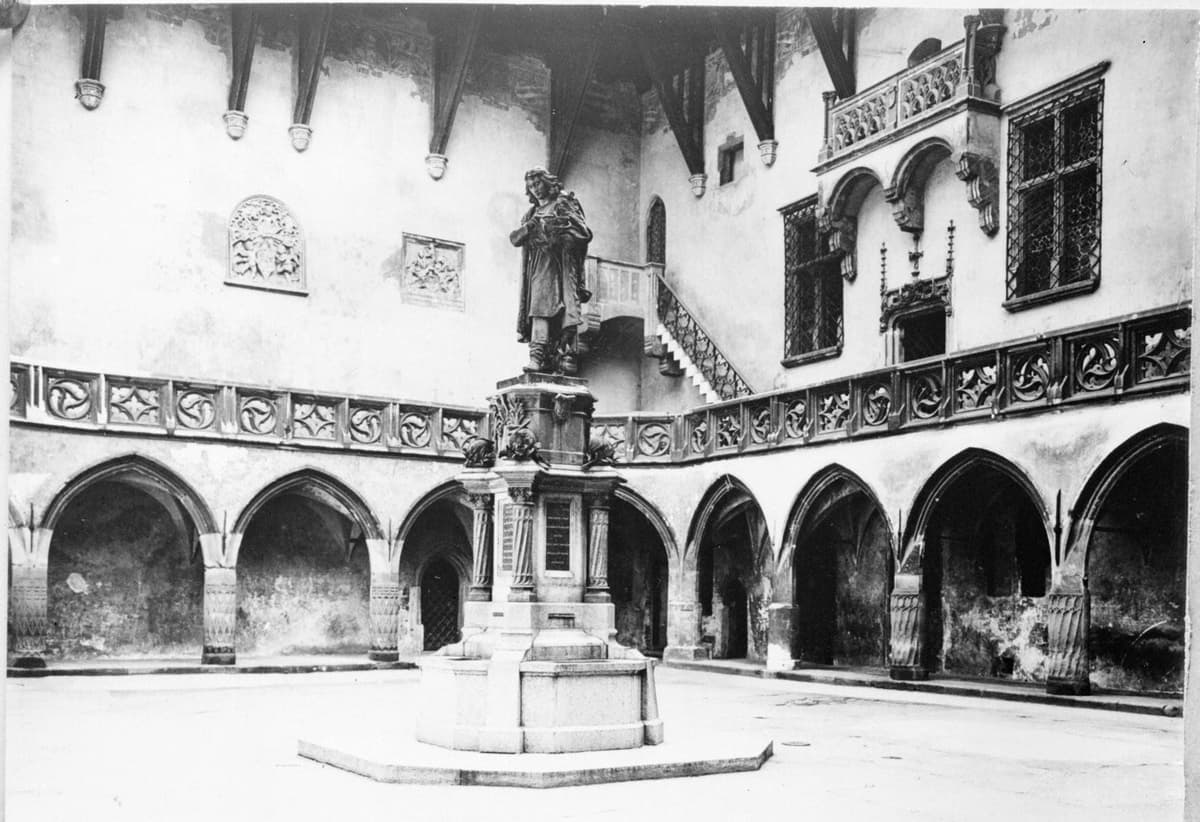
Collegium Maius, at Jagiellońska 15 in Kraków Old Town, is the Jagiellonian University's old main college, where Copernicus enrolled in 1491. Its arcaded courtyard is open every day and its clock plays five times a day. The rooms are a paid museum, seen alone or with a guide, and free on Wednesday afternoons.
Updated
Key facts
- Courtyard
- Every day, 09:00 to 17:00The clock plays five times a day
- Ticket
- PLN 17On your own; guided tour PLN 26
- Free day
- Wednesday afternoonVisits on your own
- Hours
- Monday to SaturdayTuesday to Friday afternoons only
- Address
- Jagiellońska 154 min on foot from the Main Square
- Built
- 1492–1497The late Gothic courtyard
The courtyard and the clock
The courtyard is open every day, 09:00 to 17:00. After the fires of 1462 and 1492 the college's houses were joined round it, and its late Gothic cloisters with crystal vaults date from 1492–1497. The "professors' stairs" break the line of arcades and lead up to the gallery of the first floor.
The clock on the courtyard plays five times a day, every two hours. Its figures walk out in a procession: the beadle, Queen Jadwiga, King Władysław Jagiełło, St John of Kęty, Hugo Kołłątaj and Rector Stanisław of Skalbmierz. The music is a piece of court music of the 16th century from the tablature of Jan of Lublin, followed by Gaudeamus Igitur.
The present clock was started on 30 September 2000. It is the fourth clock in the building's history; the first was made, most probably, before 1465.
The museum: tickets, hours and tours
Jagiellonian University Museum
- On your own
- PLN 17
- Reduced PLN 10
- Guided tour
- PLN 26
- Reduced PLN 14
- Monday
- 09:00 to 16:00
- Tuesday to Friday
- 13:30 to 16:00
- Free on Wednesdays
- Saturday
- 10:00 to 15:00
- Last entry
- 30 min before closing
The rooms of Collegium Maius are the Jagiellonian University Museum. Its historic interiors include the Libraria, the old library hall of 1516–1540, entered through a Gothic portal called the Golden Gate (Porta Aurea), the Stuba Communis, once the dining hall, the treasury and the professors' rooms.
Visits on your own run from Monday to Saturday, in the afternoon only from Tuesday to Friday, and are free on Wednesdays. Guided tours start on weekday mornings from Tuesday to Friday, in Polish and English, and on some days in French, Spanish or Bulgarian. They lead through the Stuba Communis, the two treasuries, the Libraria, the room of globes and the gallery of medieval sculpture.
The room of globes holds the only pair of globes in Poland from the workshop of Gerard Mercator, beside large library globes from Willem Blaeu’s workshop in Amsterdam. Tickets are sold at the museum’s box office and online. The museum may change its route and hours for the university’s ceremonies.
Copernicus in Collegium Maius
Nicolaus Copernicus enrolled at the university in 1491, with his brother. A copy of the page of the register with their names hangs in the museum, and the two studied at the Faculty of Liberal Arts.
The museum keeps astronomical instruments that reached Kraków in 1493, while Copernicus was a student. In the Libraria stand three wooden replicas of instruments he used: a quadrant, a triquetrum and an armillary sphere.
The Copernicus Room itself is closed for works; some of its pieces can be seen in the rooms of globes on a guided tour.
The university in brief
King Casimir the Great founded the university on 12 May 1364 as the Studium Generale, with three faculties: liberal arts, medicine and law. King Władysław Jagiełło re-founded it on 26 July 1400, and Queen Jadwiga had left a large part of her own estate to it in her will. In 1400 the king gave the university a house bought from the Kraków alderman Piotr Gerhardsdorf.
The main college was first called the Royal College (Collegium Regium) and then the Greater College (Collegium Maius). The university has been called the Jagiellonian University since 1817.
1364
The university is founded by King Casimir the Great.
1400
The university is re-founded, and the king gives it a house bought from Piotr Gerhardsdorf.
1492–1497
After the fires of 1462 and 1492 the houses are joined round the arcaded courtyard.
1516–1540
The Libraria, the library hall, is built.
1817
The university takes the name Jagiellonian University.
1840–1870
The building is rebuilt in neo-Gothic style for the Jagiellonian Library.
1940
The library leaves the building.
1949–1964
At Karol Estreicher's initiative the college is restored to its look from before 1840.
The university quarter on foot
A loop of 940 m from the Main Square takes in Collegium Maius, the gate of the Professors' Garden, Collegium Novum and St Anne's church, and comes back to the square: 13 min on foot.
Collegium Novum, the university's new main college, was built in 1887. On 6 November 1939 the German authorities called nearly 180 scholars and staff of the university to a meeting there, arrested them and sent them to concentration camps.
The Professors' Garden behind Collegium Maius is first mentioned in the university's records in 1467. It was opened to visitors on 12 May 2010, with cobbled paths, benches, sculptures of professors, a sundial and a model of an armillary sphere, and is now closed until further notice. St Anne's church stands at the end of the loop, on św. Anny.
- Main SquareThe middle of the square, by the Cloth Hall
- Collegium MaiusThe courtyard and the museum, Jagiellońska 15
- Professors’ GardenThe gate from Jagiellońska
- Collegium NovumThe university’s new main college
- St Anne’s churchThe church on św. Anny
4 min walk
Collegium Maius
290 mThe gateway on Jagiellońska
5 min walk
Professors’ Garden
320 mThe gate from Jagiellońska
5 min walk
Collegium Novum
370 mThe university’s new main college
5 min walk
St Anne’s church
340 mOn św. Anny
Frequently asked questions
When is the Collegium Maius courtyard open?
Every day, 09:00 to 17:00. The courtyard is entered from Jagiellońska, and the clock on it plays five times a day.
How often does the Collegium Maius clock play?
Five times a day, every two hours. Figures of the university's history walk out to court music of the 16th century and Gaudeamus Igitur.
Is Collegium Maius free on Wednesdays?
Yes. Visits on your own are free on Wednesdays, 13:30 to 16:00, and the last entry is 30 minutes before closing. On other days the ticket costs PLN 17 on your own and PLN 26 with a guide.
Did Copernicus study at Collegium Maius?
Copernicus enrolled at the university in 1491 and studied at its Faculty of Liberal Arts. The museum keeps instruments that reached Kraków in 1493, while he was a student, and replicas of instruments he used.
Do you need a guide to visit Collegium Maius?
No. Visits on your own run from Monday to Saturday, in the afternoon only from Tuesday to Friday. Guided tours start on weekday mornings from Tuesday to Friday and lead through the Stuba Communis, the treasuries, the Libraria, the room of globes and the gallery of medieval sculpture.