History of Kraków Old Town
Kraków Old Town grew below Wawel Hill, home of Polish rulers from the middle of the 11th century. The town received its charter under Magdeburg law on 5 June 1257, with the grid of streets round the Main Square. Kings were crowned on Wawel until 1734, and in 1978 the Old Town joined the first UNESCO list.
Updated
Key facts
- First record
- 965The name first appears in writing
- Town charter
- 5 June 1257Under Magdeburg law
- Coronations
- 1320 to 1734Court moved to Warsaw 1596–1611
- UNESCO
- Listed in 1978One of the first twelve sites
- Second World War
- Escaped destructionNo siege and no street fighting
Before the charter
Kraków was an organised centre by about the 7th or 8th century, and power sat on Wawel Hill from the start. Two mounds, named after Krakus and Wanda, remain from its first inhabitants. In the 8th century Kraków was a political centre of the Vistulan tribe, and its name first appears in writing in 965.
About 990 the stronghold became part of the Piast state, and from about 1000 Kraków was a bishop's seat. Under Casimir the Restorer it became the main seat of the dukes, and from the middle of the 11th century Wawel Hill was the residence of Polish rulers. Mieszko I, the first historical ruler of Poland, had already made the hill one of his residences.
Below the hill grew a settlement called Okół, with its first traces from the turn of the 8th and 9th centuries. The first Tatar raid destroyed it in the middle of the 13th century. Only the fortified church of St Andrew, where the people took shelter, survived.
The charter of 1257 and the grid of streets
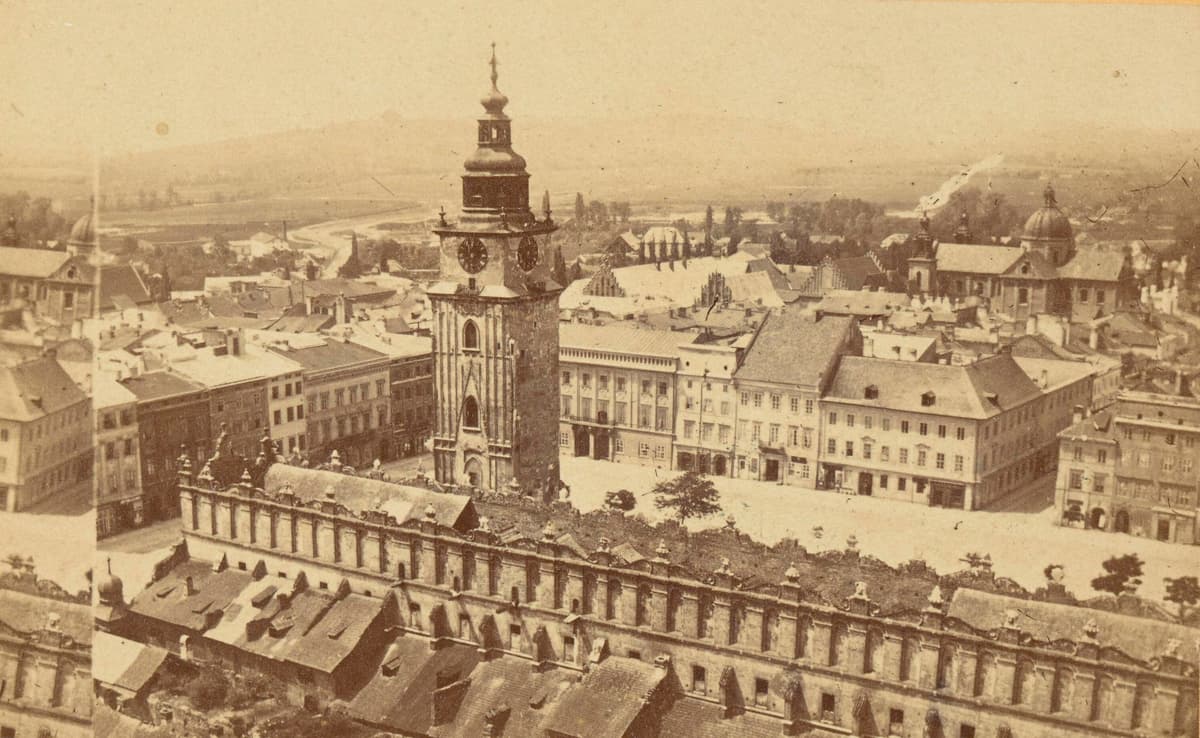
Duke Bolesław the Chaste (Bolesław Wstydliwy) granted Kraków its charter under Magdeburg law on 5 June 1257. The town was laid out on a regular grid of quarters, and its main streets leave the corners of the Main Square, a square of about 200 by 200 m.
Kanonicza, the street that leads to Wawel, is older than the charter: it ran through Okół. The town walls began to go up at the end of the 13th century.
The capital and the kings
In 1320 Władysław Łokietek was crowned in Wawel Cathedral, which ended the period of division, and kings were crowned in Kraków until 1734. The university was founded on 12 May 1364. The capital reached its peak in the 15th and 16th centuries, and in the 16th it was the main centre for bringing the ideas of the Renaissance from Italy.
From 1596 King Sigismund III Vasa moved the royal court to Warsaw, a move completed in 1611. Kraków remained the formal capital until the last partition of Poland.
1320
Władysław Łokietek is crowned in Wawel Cathedral.
12 May 1364
The university is founded.
1492–1497
The late Gothic arcaded courtyard of Collegium Maius is built.
1596–1611
Sigismund III Vasa moves the royal court to Warsaw.
1655
The Swedes shell Wawel with cannon from the Wielopolski Palace.
17 January 1734
The last coronation in Wawel Cathedral, of Augustus III and Maria Józefa.
1794
Tadeusz Kościuszko takes his oath on the Main Square, and the Kościuszko Uprising begins.
The walls and their end
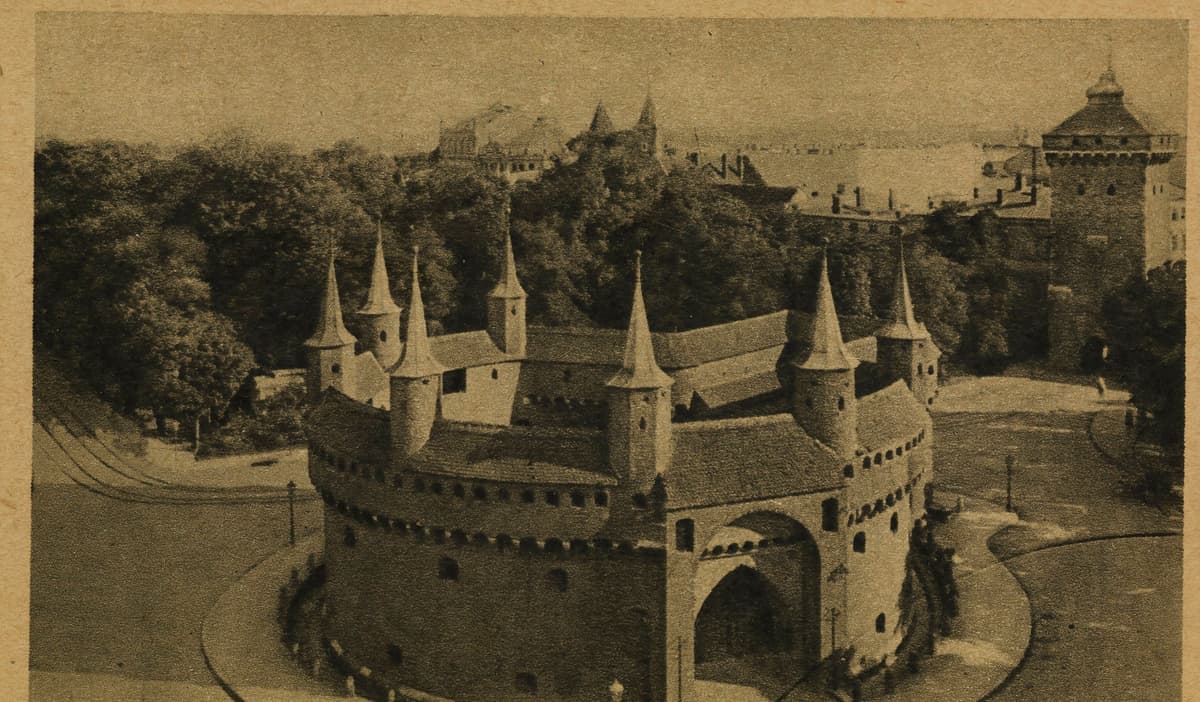
The town walls went up from the end of the 13th century, and in the 15th century a ring of modern fortifications closed round the town. The Barbican, St Florian’s Gate and the Carpenters’, Haberdashers’ and Joiners’ towers survive from it.
Emperor Francis II's decree of 1806 began the removal of the walls. Most of them came down in 1810–1814 and in the first years of the Free City of Kraków, 1815–1846. In 1817 Feliks Radwański, an architect and senator of the Free City, saved the northern stretch with the Barbican. The moat was filled in, and the Planty were laid out in its place.
The Austrian century
After the third partition of Poland the Austrians took Kraków. From 1815–1846 it was the formally independent Free City of Kraków, which modernised and enlarged the town. A great fire swept Kraków in 1850.
Under Galician autonomy Józef Dietl was the first president of Kraków, 1866–1874. The effort to win Wawel back took 1860–1911.
Under the partitions Kraków was a centre of the movement for independence: in 1914 Józef Piłsudski's First Cadre Company set out from here to fight. At the end of the 19th century the town was the cradle of the Young Poland movement in art.
The war years and why the town stands
The German army entered Kraków on 6 September 1939, and the town became the administrative capital of the Generalgouvernement.
The town escaped destruction in the Second World War. There was no siege and no street fighting in the fortified town: a historian of the Museum of Kraków puts this down to the situation at the front and a run of favourable circumstances, not to the tactics of the attackers. Soviet troops entered Kraków in January 1945.
The UNESCO listing and what it covers
In 1978 the Historic Centre of Kraków was put on the World Heritage List, one of the twelve sites on the first list, with Wieliczka as the other Polish one. It is formed by three ensembles: the medieval chartered town inside the Planty, Wawel Hill, and Kazimierz with Stradom, a town chartered in 1335.
The listing rests on criterion (iv): the historic centre "admirably illustrates the process of continuous urban growth from the Middle Ages to the present day". The property covers 149.65 ha, and since 2010 a buffer zone of 907.35 ha has surrounded it.
In December 1978, three months after the listing, the Social Committee for the Restoration of Kraków's Monuments (SKOZK) was set up. Since 1994 the historic town has also been a Monument of History, Poland's own listing, and the Old Town, the Planty and Wawel Hill form the Old Town cultural park.
The legends of Kraków
The legends of Kraków belong to places in the Old Town and on Wawel.
The trumpeter
In the 13th century a watchman on St Mary's tower saw the Tatars coming and sounded the alarm until an arrow struck his throat. The city ties the legend to the raid of 1241, and the hejnał still breaks off at that note.
The Wawel Dragon
The chronicle of Wincenty Kadłubek tells of a cruel and greedy monster in a cleft of a rock: the Wawel Dragon.
The pigeons
A witch turned the knights of Duke Henry IV Probus into pigeons to win gold for his crown, and they still wait for him on the Main Square.
The two towers
Two brothers built the towers of St Mary's, and the younger, out of jealousy, killed the elder.
The Lajkonik
In 1287 a Tatar horde reached the town during the Corpus Christi procession, while its knights were away at war, and the raftsmen set out against it. The Lajkonik, whose costume of a Tatar rider Stanisław Wyspiański designed in 1904, comes from this legend.
Pan Twardowski
Pan Twardowski is one of the figures of Kraków legend, and his story has been staged at the Barbican.
The coat of arms
The coat of arms of the Royal Capital City of Kraków shows a red brick wall on a blue field, with three crenellated towers, the middle one higher and wider. In the wall is a gate with open golden doors and a raised golden portcullis, and in the gateway stands the crowned White Eagle with a golden beak and claws.
The city’s colours are white and blue.
Frequently asked questions
How old is Kraków?
Kraków was an organised centre by about the 7th or 8th century, and in the 8th century a political centre of the Vistulans. Its name first appears in writing in 965. The town inside the Planty received its charter under Magdeburg law on 5 June 1257.
When was Kraków the capital of Poland?
Polish rulers lived on Wawel from the middle of the 11th century, and kings were crowned in Kraków from 1320 to 1734. Sigismund III Vasa moved the royal court to Warsaw in 1596–1611, but Kraków remained the formal capital until the last partition of Poland.
Why was Kraków not destroyed in the Second World War?
The fortified town escaped a siege and street fighting. A historian of the Museum of Kraków puts this down to the situation at the front and a run of favourable circumstances, not to the tactics of the attackers. Soviet troops entered Kraków in January 1945, and the town escaped destruction.
What does Kraków’s UNESCO World Heritage site include?
The Historic Centre of Kraków, listed in 1978, is formed by three ensembles: the medieval town inside the Planty, Wawel Hill, and Kazimierz with Stradom. It covers 149.65 ha, and a buffer zone of 907.35 ha has surrounded it since 2010.
What is on Kraków’s coat of arms?
A red brick wall with three crenellated towers on a blue field, with a gate of open golden doors under a raised golden portcullis, and the crowned White Eagle in the gateway. The city’s colours are white and blue.