Planty Park, Kraków
The Planty are the park that rings Kraków Old Town on the line of its medieval walls and moat. The ring is about 4 km long, covers 20.4 ha and is divided into eight gardens. It was laid out from 1822, is free to enter and has no closing time, and leads from the Barbican to Wawel on both sides.
Updated
Key facts
- Length of the ring
- About 4 km40 m to 120 m wide
- Area
- 20.4 haIn eight gardens
- Laid out
- From 1822On the line of the city walls
- Entry
- FreeA public park
- Open
- Day and nightQuiet is kept from 22:00 to 06:00
- Cycling
- Allowed, slowlyAt most 20 km/h, walkers first
What the Planty are and why they follow the walls
Where the Planty lie, the city walls once stood behind a moat. In 1820 the Senate of the Free City of Kraków decided to pull down what was left of the walls, fill the moat and drain the marshes, and the works on the park began in 1822. The trees planted were mostly horse chestnuts.
The idea was above all Feliks Radwański's, a professor of the Jagiellonian University, who also argued for keeping St Florian's Gate and the Barbican. Florian Straszewski took the plan up, and a street on the ring bears his name. The name Planty comes from a word for levelling the ground.
Between the Barbican and St Florian’s Gate a strip of stone setts in the paths marks where the walls ran.
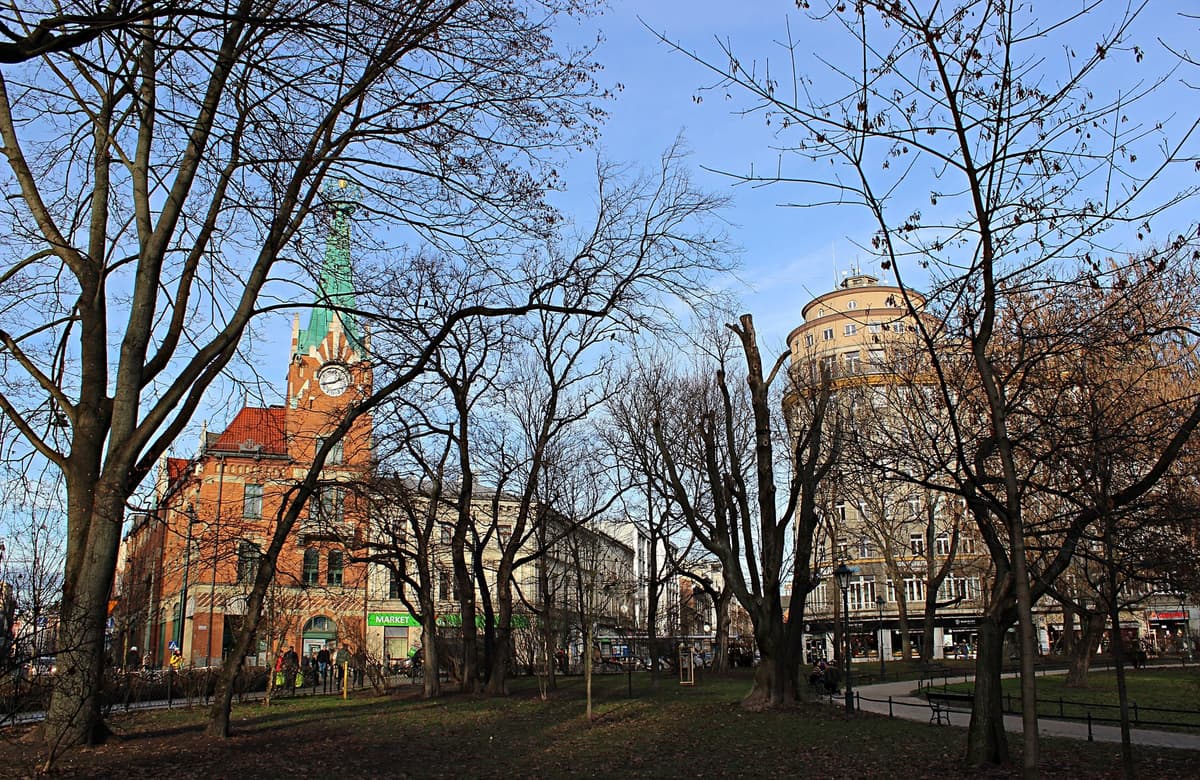
Walking the ring
The ring is about 4 km long and between 40 m and 120 m wide. It runs from the Barbican round both sides of the Old Town to Wawel Hill: the western half, past the university, is about 1.5 km (19 min on foot) between the Barbican and Wawel gardens, and the eastern half, past the station side and Stradom, about 2.0 km (24 min on foot).
Seven streets close the ring on the outside: Westerplatte, św. Gertrudy, Podzamcze, Straszewskiego, Podwale, Dunajewskiego and Basztowa.
- Barbakan gardenOn the north side, round the Barbican and St Florian’s Gate.
- Dworzec gardenOn the north-east, the side of the main station.
- Gródek gardenOn the east side.
- Stradom gardenOn the south-east, towards Stradom.
- Wawel gardenOn the south-west, towards Wawel.
- Uniwersytet gardenOn the west side, by Collegium Novum.
- Pałac Sztuki gardenOn the west, by plac Szczepański and the Pałac Sztuki.
- Florianka gardenOn the north-west.
- Jadwiga and Jagiełło monumentA monument by the Barbican.
- The HarpistA monument in the Planty.
- Artur Grottger monumentA monument in the Planty.
- Copernicus monumentAt the end of Gołębia, by the university.
- Chopin’s PianoA fountain in the Planty.
- Grażyna and Litawor monumentA monument in the Planty.
- Tadeusz Boy-Żeleński memorialA memorial in the Planty.
- Plantuś playgroundA playground by Poselska.
- Dzikie Planty playgroundA playground by św. Gertrudy.
The eight gardens
The park is divided into eight gardens, each named after what stands beside it.
Barbakan garden
On the north side, round the Barbican and St Florian’s Gate.
Dworzec garden
On the north-east, the side of the main station.
Gródek garden
On the east side.
Stradom garden
On the south-east, towards Stradom.
Wawel garden
On the south-west, towards Wawel.
Uniwersytet garden
On the west side, by Collegium Novum.
Pałac Sztuki garden
On the west, by plac Szczepański and the Pałac Sztuki.
Florianka garden
On the north-west.
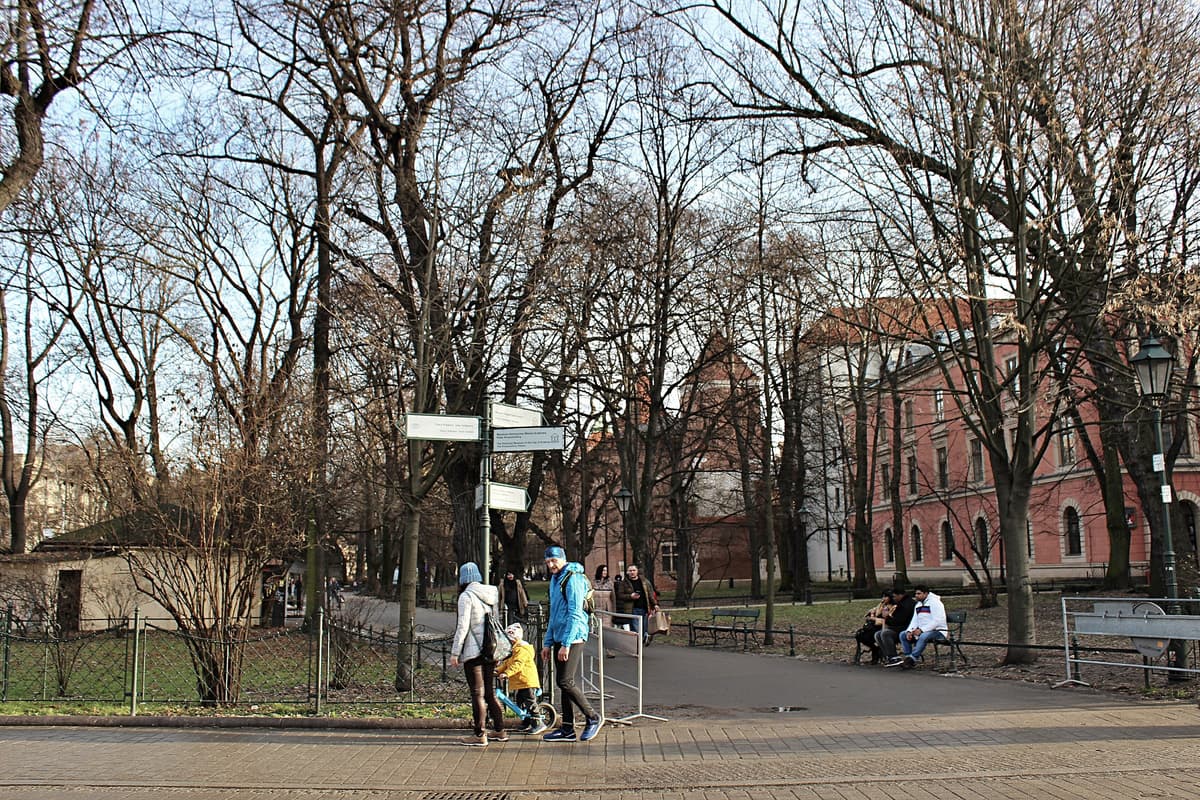
Monuments, a fountain and playgrounds
The Planty hold a row of monuments: to Michał Bałucki, the lyrist Bojan, Jadwiga and Jagiełło, Lilla Weneda, Artur Grottger, Nicolaus Copernicus, Grażyna and Litawor, and Tadeusz Boy-Żeleński. The Copernicus monument, at the end of Gołębia, first stood in the courtyard of Collegium Maius.
The Chopin's Piano fountain is in the park, and the Lantern of the Dead stands at the end of św. Sebastiana. There are two playgrounds, Plantuś by Poselska and Dzikie Planty by św. Gertrudy. Three old kiosks remain, at the ends of Szewska and Sławkowska and near the Słowacki Theatre.
The park’s rules, toilets and the night
Open at night, quietly
The park's rules set no closing time. Quiet has to be kept from 22:00 to 06:00.
Bicycles and scooters
Riding is allowed at about walking pace and never faster than 20 km/h, and walkers have priority. Shared bikes and scooters may not be left in the park.
Not allowed
Smoking, e-cigarettes included, camping, lighting fires and barbecues are forbidden.
Toilets
Public toilets stand in the Planty at Sienna, Straszewskiego and św. Tomasza, the last of them by plac Szczepański.
Tram and bus stops on the ring
The stops beside the park, as the city’s parks board lists them, and the walk from each to the middle of the Main Square.
| Stop | To the Main Square |
|---|---|
| Stary Kleparz | 7 min on foot, 590 m |
| Teatr Słowackiego | 10 min on foot, 750 m |
| Dworzec Główny Zachód | 15 min on foot, 1.1 km |
| Poczta Główna | 6 min on foot, 450 m |
| Św. Gertrudy | 7 min on foot, 570 m |
| Stradom | 16 min on foot, 1.2 km |
| Wawel | 12 min on foot, 900 m |
| Plac Wszystkich Świętych | 5 min on foot, 360 m |
| Filharmonia | 5 min on foot, 450 m |
| Teatr Bagatela | 5 min on foot, 420 m |
Frequently asked questions
How long is the walk around the Planty in Kraków?
The ring round the Old Town is about 4 km long. Between the Barbican and Wawel the western half is about 1.5 km (19 min on foot) and the eastern half about 2.0 km (24 min on foot), so either half makes a walk from one end of the Old Town to the other through the trees.
Can you cycle in the Planty?
Yes. Bicycles and scooters may ride in the park at about walking pace and never faster than 20 km/h, and they give way to people on foot. Shared bikes and scooters may not be parked there.
Are the Planty open at night?
Yes. The park's rules set no closing time. Quiet must be kept from 22:00 to 06:00.
Why is there a park all round Kraków Old Town?
The park stands where the medieval walls and their moat ran. In 1820 the Senate of the Free City decided to pull down the remains of the walls and fill the moat, and from 1822 the ground was planted as a public promenade.