Kraków Main Square (Rynek Główny)
Rynek Główny
The Main Square (Rynek Główny) is the market square of Kraków Old Town, laid out in 1257 on a plan about 200 m a side. The Cloth Hall stands in its middle, with St Mary's Basilica, St Adalbert's church and the Town Hall Tower around it. The bugle call sounds over it from St Mary's every hour.
Updated
Key facts
- Size
- About 200 m a sideLaid out in 1257
- Streets
- Three from each sideGrodzka runs at an angle
- Town Hall Tower
- Paid, PLN 22Free on Mondays
- Tower season
- March to November110 steps up
- Bugle call
- Every hour, day and nightFrom St Mary’s taller tower
What stands on the Main Square
The square was laid out in 1257, where old trade routes crossed, on a plan with sides of slightly over 200 m. Three streets leave each side. Only Grodzka runs at an angle: it follows the old trade route, and the plan gave way to St Mary's and St Adalbert's, which already stood there.
The Cloth Hall stands in the middle, a market hall then and now and a branch of the National Museum. Around it stand the small St Adalbert’s church, the lone tower of the town hall pulled down in the 19th century, and St Mary’s Basilica.
A ring of café and restaurant gardens lines the square, and cafés and clubs in cellars are a mark of the centre of Kraków. On the open paving only the cafés in the Town Hall Tower's cellars and in the Cloth Hall may set out tables, on at most 250 m² each.
Cloth Hall
The market hall in the middle of the square: stalls on the ground floor, a gallery of 19th-century Polish art upstairs.
St Mary’s Basilica
The church with two unequal towers, the Veit Stoss altarpiece and the bugle call.
Rynek Underground
The museum under the square, among the cellars of its old trading halls.
A walk round the square
The places on and around the Main Square, with the walk to each from the middle of the square, by the Cloth Hall.
- Cloth HallThe market hall in the middle of the square.
- Adam Mickiewicz monumentThe poet’s monument, where Kraków people arrange to meet.
- St Mary’s BasilicaVisitors enter by the south door, on plac Mariacki.
- Mały RynekThe smaller square just behind St Mary’s.
- St Adalbert’s churchThe small church at the end of Grodzka.
- Town Hall TowerWhat is left of the town hall, at Rynek Główny 1.
- Eros BendatoIgor Mitoraj’s head, lying on the paving.
- Krzysztofory PalaceThe main seat of the Museum of Kraków, at number 35.
- Plac SzczepańskiA square opened up in the early 19th century.
- Rynek UndergroundThe museum in the cellars under the square.
- Grey HouseTwo medieval houses joined into one, later a palace.
1 min walk
The museum in the cellars under the square.
2 min walk
St Adalbert’s church
100 mThe small church at the end of Grodzka.
2 min walk
Town Hall Tower
80 mWhat is left of the town hall, at Rynek Główny 1.
2 min walk
Eros Bendato
100 mIgor Mitoraj’s head, lying on the paving.
3 min walk
St Mary’s Basilica
180 mVisitors enter by the south door, on plac Mariacki.
3 min walk
Krzysztofory Palace
170 mThe main seat of the Museum of Kraków, at number 35.
4 min walk
Mały Rynek
240 mThe smaller square just behind St Mary’s.
5 min walk
Plac Szczepański
320 mA square opened up in the early 19th century.
The Town Hall Tower
Climbing the tower
- Season
- March to November
- Tuesday to Sunday
- 10:00 to 18:00
- Mondays
- 11:00 to 16:00
- Ticket
- PLN 22
- Reduced PLN 16, free on Mondays
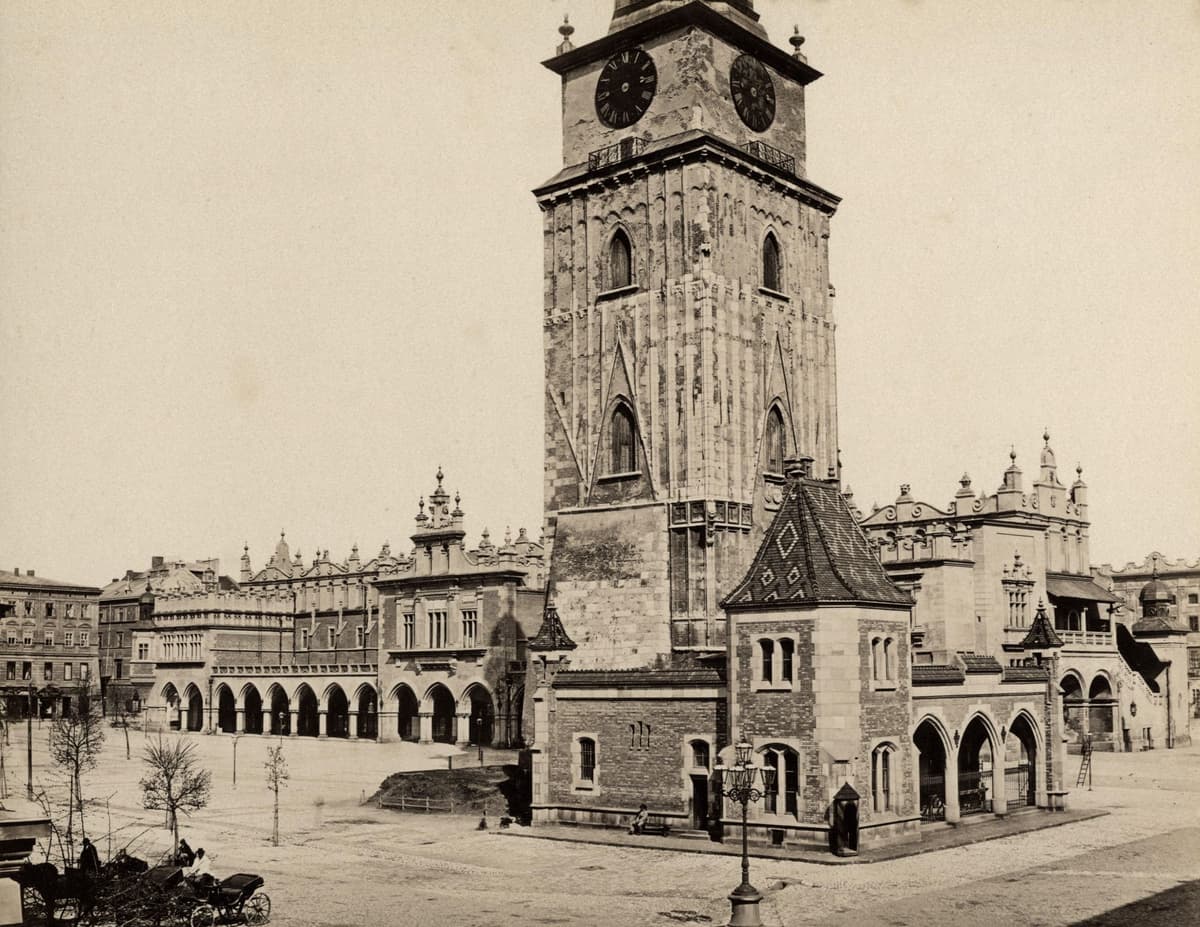
The tower, of 1383, is what is left of the Gothic town hall. The decision to pull the town hall down was taken in 1820, and the tower and the cellars were spared. It stands in the south-west part of the square, at Rynek Główny 1, 2 min on foot from its middle.
The tower is over 70 m high, built of brick and stone, and its walls lean about 55 cm from the vertical. Narrow stone stairs inside the wall, 110 steps, lead to the upper rooms. The works of the old town clock stand on the top floor: the tower has carried a clock since the 16th century. The Baroque helmet dates from about 1783.
A ticket is valid on the day it is bought, and entry is free on Mondays. The stairs cannot be climbed in a wheelchair, and there is no cloakroom and no toilet inside. Two stone lions flank the wide steps up to the door, and the cellars hold a theatre stage and a café.
The Adam Mickiewicz monument
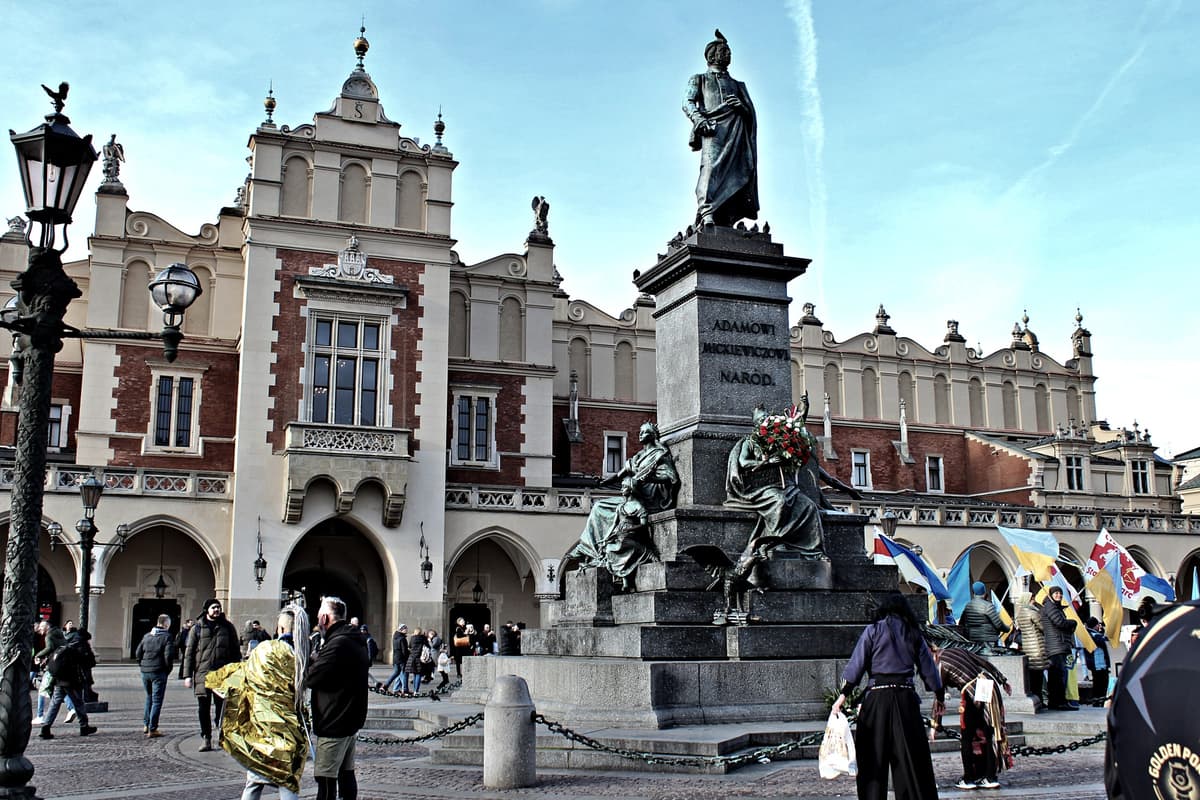
The monument to the poet Adam Mickiewicz was unveiled on 26 June 1898, a hundred years after his birth, with his daughter and son present. It is the work of Teodor Rygier: the poet stands on a pedestal, and four seated figures at his feet stand for the Homeland, Learning, Valour and Poetry. The dedication on the base reads "Adamowi Mickiewiczowi Naród", to Adam Mickiewicz from the nation.
The occupying Germans destroyed it on 17 August 1940. After the war it was rebuilt from parts found in a scrapyard in Hamburg in 1946, and unveiled again on 26 November 1955.
Kraków people arrange to meet "pod Adasiem", at the monument. Every year on 24 December, the poet's name day, Kraków's flower sellers lay flowers at its foot.
St Adalbert’s church
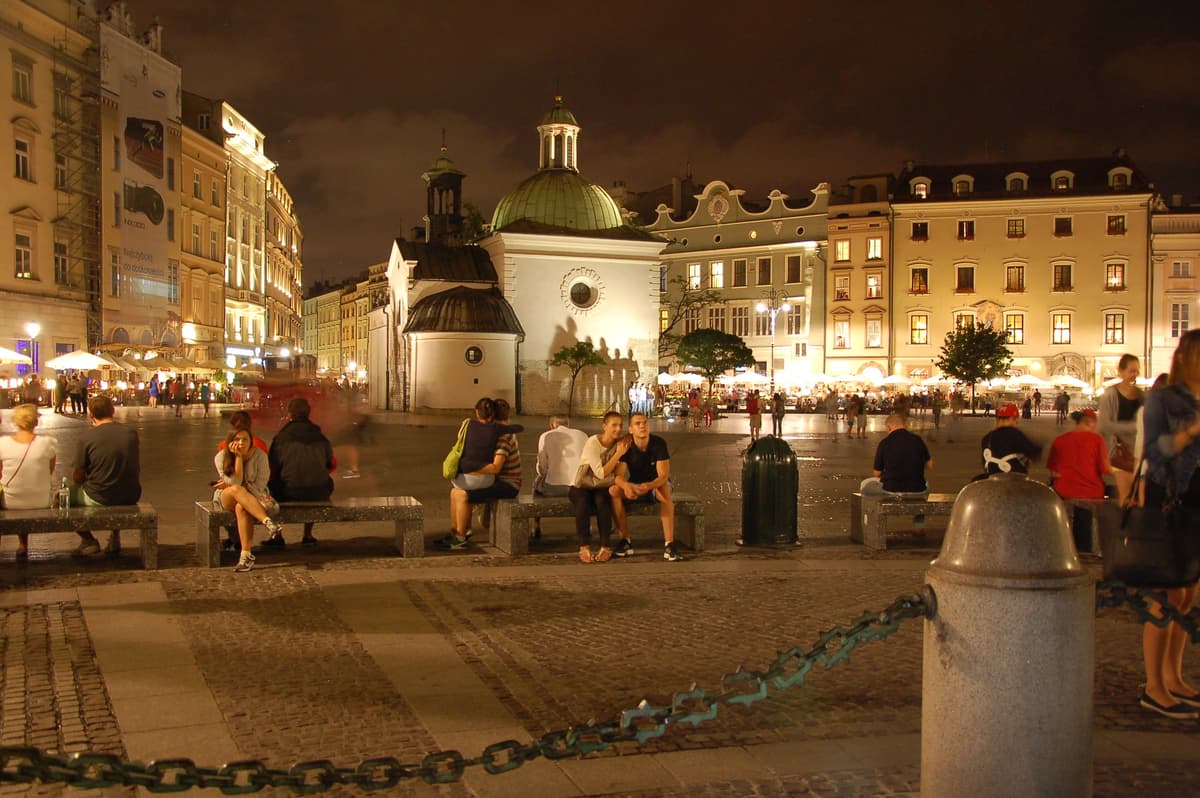
The small church of St Adalbert (kościół św. Wojciecha) stands on the square at the end of Grodzka. It was built in the 11th or 12th century where wooden buildings had stood before, and tradition holds that St Adalbert preached here before his mission to Prussia.
In 1611–1618 the walls were raised, the floor was lifted and the nave was given its Baroque dome. On the south side the ground is lowered, with a way down to a museum under the church, where the old ground levels and walls can be seen. The church is one of the churches of the Old Town.
Eros Bendato, the head on the square
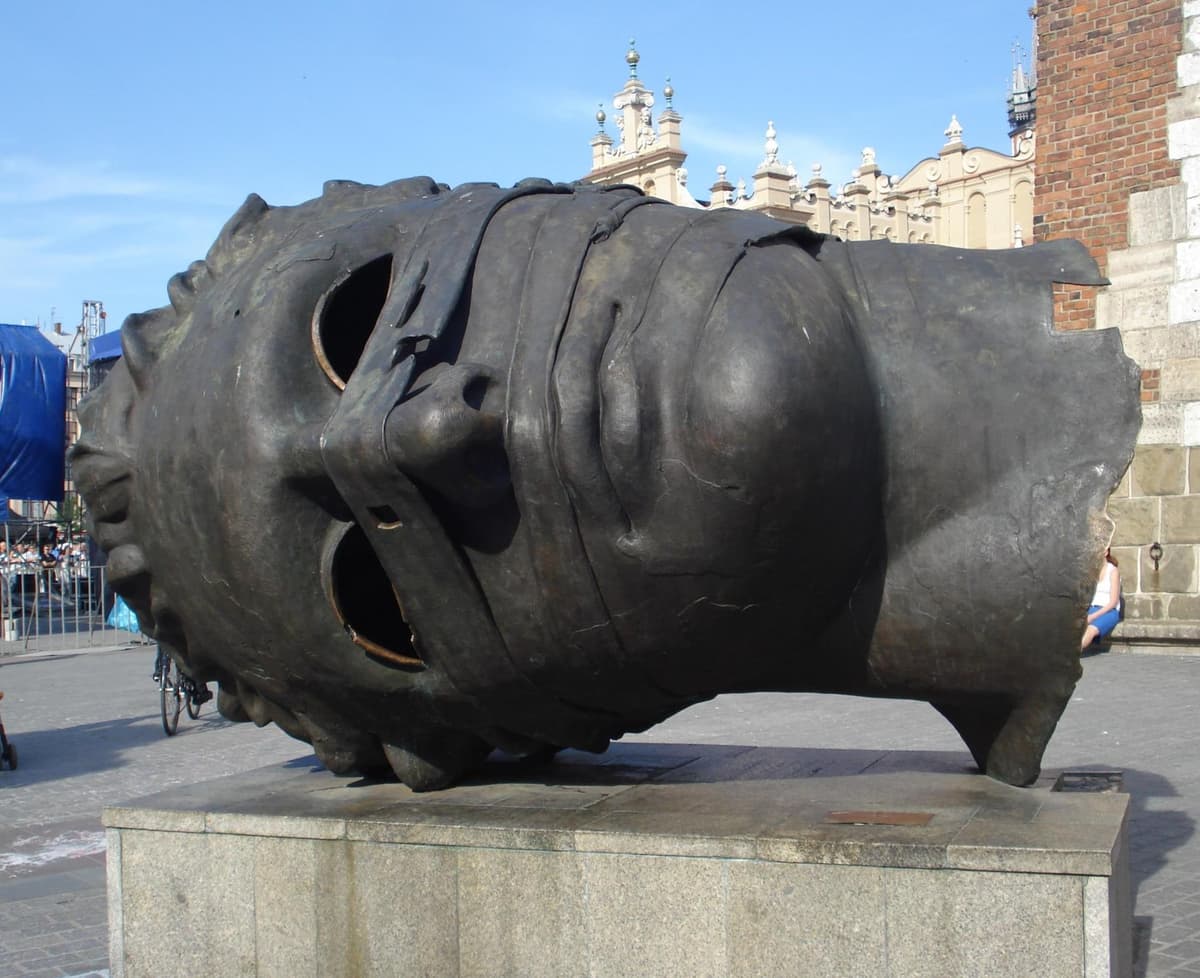
Eros Bendato (Eros Bound) is a monumental head by the sculptor Igor Mitoraj, bandaged and without eyes, lying straight on the paving of the square.
It came for an exhibition of his work in 2003, when the International Cultural Centre showed 14 of his sculptures in its gallery and on the Main Square. The head stayed in Kraków after the exhibition, and the artist gave it to the city in 2005.
Houses and palaces on the square
Three of the palaces and town houses that face the Main Square.
Palace and museum
Krzysztofory Palace
The palace takes its name from a Gothic figure of St Christopher that once stood on its front. It is the main seat of the Museum of Kraków, and its permanent exhibition, "Kraków od początku, bez końca" (Kraków from the beginning, without end), is free on Tuesdays.
- Address
- Rynek Główny 35
Palace
Pałac pod Baranami (Palace under the Rams)
The name comes from the rams' heads on the balcony. A Renaissance arcaded courtyard from a rebuilding before 1577 partly survives, and the rooms upstairs keep their Louis XVI decoration.
- Address
- Rynek Główny 27
Town house
Grey House (Szara Kamienica)
Legend says King Casimir the Great built it in the 14th century for Sara, and that the name comes from her. In fact it was made in the 15th century by joining two houses, and about 1540 it became a patrician palace. Henry of Valois was received here after his coronation, in February 1574. In 1794 it held Kościuszko's headquarters, and in 1846 the National Government of the Kraków Uprising. Józef Mehoffer designed the interior and the painted vault of its shop.
In 1785 only four houses on the square counted as palaces: Spiski, Krzysztofory, Pod Baranami and Margrabski. Krzysztofory is one of the museums in the Old Town.
Flower sellers, carriages and pigeons
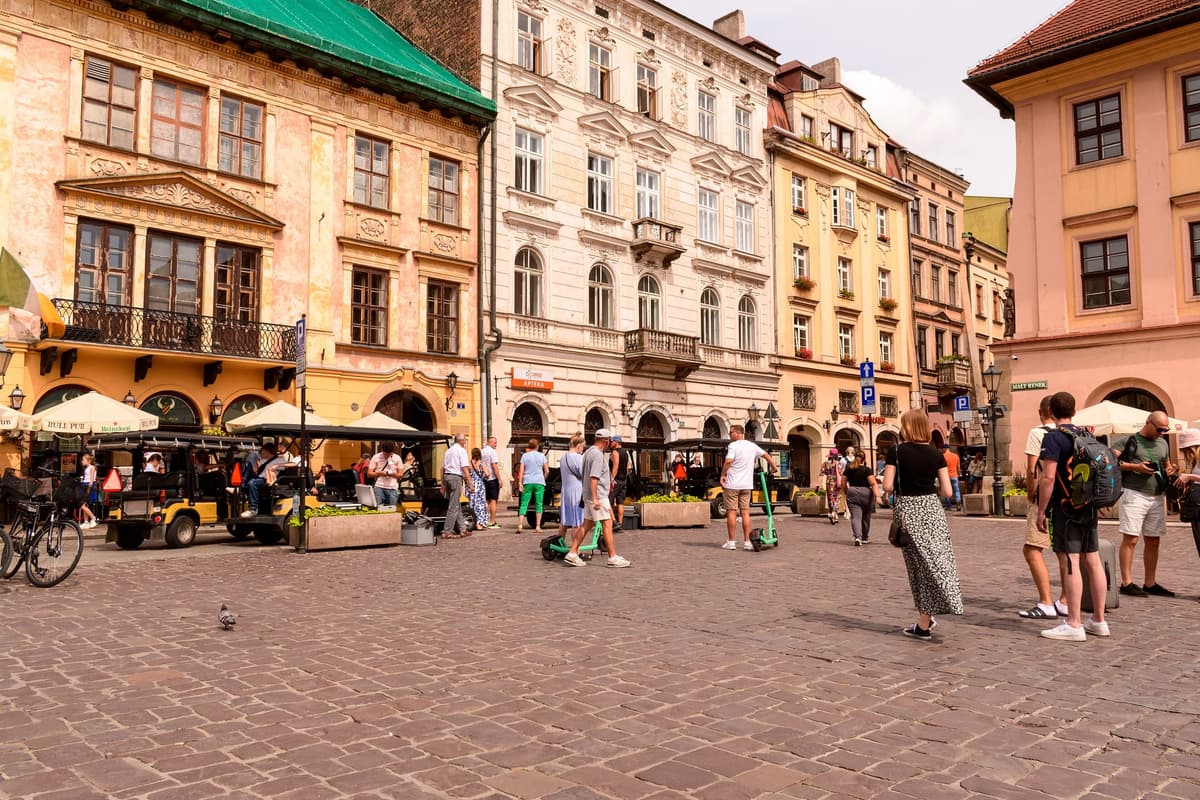
Flower stalls, horse-drawn carriages and pigeons belong to the square. The rules of the Old Town cultural park keep the flower sellers on the Main Square, and street performers play there with a permit or a contract with the city. The carriages wait for passengers on the square.
A legend explains the pigeons. Duke Henry IV Probus wanted to become king but could not pay for the Pope’s support. A witch turned his knights into pigeons, which flew to the towers of St Mary’s and pecked at the walls until gold coins fell. The duke spent the money before he reached Rome and never came back, and his knights, still pigeons, wait for him on the square.
Mały Rynek and plac Szczepański
Mały Rynek (the Small Square) lies just behind St Mary's, 4 min on foot from the middle of the Main Square. Over time it traded above all in meat and fish, and from the 18th century it was called the Butchers' Market, after the town's meat stalls that stood there. About 1820 it still had no name of its own and was simply the square in front of St Barbara's church; the name Mały Rynek appeared only in the middle of the 19th century.
Today Mały Rynek is the quieter partner of the Main Square, and fairs and food festivals are held there.
Plac Szczepański lies 5 min on foot from the middle of the Main Square. It has been open ground only since the early 19th century: St Stephen's church and its parish cemetery stood there before.
The square through the year
Christmas market
From the last Friday of November to 1 January the Christmas market stands on the square.
Nativity-scene contest
On the first Thursday of December, the makers of Kraków nativity scenes (szopki) bring their work to the square. The tradition has been on UNESCO's list of intangible heritage since 2018.
The bugle call
The hejnał is played from the taller tower of St Mary’s every hour, day and night, and can be heard on the square.
The Lajkonik
In the week after Corpus Christi, the Lajkonik, a rider on a hobby horse, leads a procession from Zwierzyniec that ends on the Main Square.
The square in history
1257
The square is laid out when the town receives its charter under Magdeburg law.
1525
Albrecht Hohenzollern, Duke of Prussia, pays homage to King Sigismund the Old on the square.
1794
Tadeusz Kościuszko takes his oath on the square and starts the Kościuszko Uprising.
1820
The town hall is to be pulled down. Its tower and cellars are spared.
The square and the grid of streets around it date from the charter, a turning point in the history of the Old Town.
Frequently asked questions
How big is the Main Square in Kraków?
The Main Square was laid out in 1257 on a square plan with sides of slightly over 200 m. Three streets leave each side, and only Grodzka runs at an angle. The Cloth Hall stands in the middle, with St Adalbert's church, the Town Hall Tower and St Mary's Basilica around it.
Can you climb the Town Hall Tower in Kraków?
Yes, from March to November. Narrow stone stairs of 110 steps lead up inside the wall to the old clock works on the top floor. A ticket costs PLN 22 and is valid on the day it is bought, and entry is free on Mondays. The tower cannot be visited in a wheelchair.
Is there a town hall on Kraków’s Main Square?
Only its tower. The Gothic town hall stood in the south-west part of the square until the decision of 1820 to pull it down. The tower, of 1383, and the cellars were spared, and the cellars now hold a theatre stage and a café.
What is the big head on the Main Square in Kraków?
It is Eros Bendato (Eros Bound), a bandaged head without eyes by the sculptor Igor Mitoraj. It came to the square for an exhibition of his work in 2003 and stayed, and the artist gave it to the city in 2005. It lies on the paving near the Town Hall Tower.
Why are there so many pigeons on Kraków’s Main Square?
A legend explains them. A witch turned the knights of Duke Henry IV Probus into pigeons, so that they could peck gold from the towers of St Mary’s to pay for his crown. The duke spent the gold on the way to Rome and never returned, and the pigeons still wait for him on the square.